


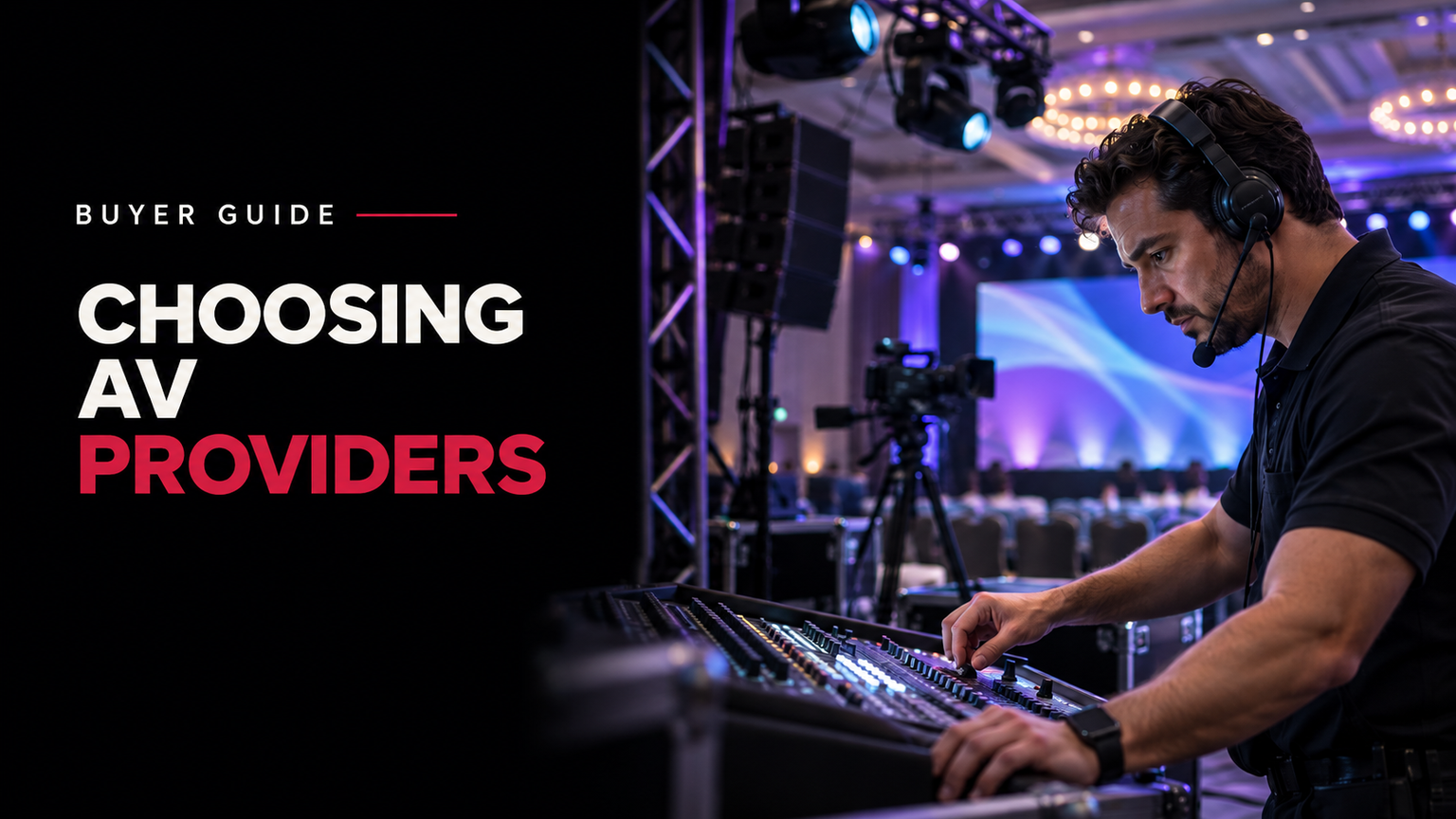
Published on November 14, 2026
Audio Visual Business: Services, Types, and How to Choose a Provider
Quick Answer
An audio visual business provides professional sound, video, lighting, presentation, conferencing, or technical production services to businesses and event organizers. Some companies rent equipment, others supply skilled AV technicians, and others design complete audiovisual systems. The right provider depends on what you need delivered, who must perform the work, and who takes responsibility for the result.
Key Takeaways
- An audio visual business can specialize in equipment rental, technical staffing, event production, installation, consulting, or ongoing support.
- Not every AV company supplies equipment and technicians together.
- Corporate events, educational institutions, hotels, healthcare organizations, and conference venues all use professional AV services.
- Technical expertise and project management can be just as important as the equipment itself.
- AV businesses can earn revenue through rentals, project-based services, installations, consulting, and recurring support agreements.
- Buyers should establish exactly what a provider includes before accepting a quotation.
What Is an Audio Visual Business?
An audio visual business is a company that provides technology, equipment, people, or professional services for producing, transmitting, displaying, and managing sound and visual content.
In professional environments, audiovisual technology often includes microphones, speakers, mixing consoles, video displays, cameras, projectors, lighting systems, conferencing equipment, and control platforms.
However, an audiovisual company does not necessarily manufacture or own all the technology it works with. Its commercial role may be to rent equipment, supply technicians, install systems, coordinate productions, or maintain technology already owned by a customer.
The professional audiovisual industry is much broader than traditional sound and video equipment. AVIXA's industry overview describes an ecosystem that includes manufacturers, systems integrators, distributors, consultants, programmers, live-event companies, technology managers, and content producers.
That distinction matters because two companies advertising audiovisual services may offer completely different solutions.
For example, a company organizing a corporate conference might need experienced audio engineers and video technicians for two days. A corporate office upgrading its meeting rooms might need an integrator to design and install a permanent conferencing system.
Both customers need audiovisual services, but they are buying different things.
What Types of Audio Visual Businesses Are There?
The easiest way to understand the industry is to look at what each type of company sells and what it agrees to deliver.
1. AV Equipment Rental Businesses
An AV equipment rental company provides temporary access to professional audiovisual equipment.
Customers may rent:
- Microphones and wireless microphone systems.
- Speakers and audio mixing consoles.
- Projectors and projection screens.
- LED video walls and display monitors.
- Cameras and video production equipment.
- Stage lighting and control equipment.
- Cables, stands, accessories, and supporting hardware.
This model is particularly useful for organizations that need equipment for occasional conferences, exhibitions, presentations, product launches, or celebrations.
Consider a company hosting a three-day conference. It may not make financial sense to purchase an entire professional sound and video setup for an event that happens only a few times each year. Renting suitable equipment can provide access without the long-term responsibilities of ownership.
However, equipment rental does not automatically include delivery, installation, operation, or technical supervision. Those services must be confirmed separately.
2. AV Technical Staffing Businesses
An AV technical staffing business supplies qualified people to operate, install, troubleshoot, and support audiovisual systems.
Its main product is professional expertise rather than equipment ownership.
Depending on the project, a staffing company may provide:
- Audio engineers.
- Lighting technicians and lighting engineers.
- Video technicians.
- LED wall technicians.
- Camera operators.
- Projectionists.
- Graphics and playback operators.
- Technical directors.
- Production managers and crew leaders.
Different technicians have different responsibilities. For example, an audio engineer manages sound signals and mixing, while a video technician may handle displays, playback systems, video routing, or LED equipment.
A technical staffing provider can be particularly valuable when a venue or event production company already has equipment but needs experienced personnel to operate it.
AV Labor Source is an example of this business model. Its website describes supplying audiovisual technicians and engineers for corporate meetings, conferences, exhibitions, product launches, and other productions.
For a practical example of its geographically targeted services, see AV technicians for corporate events in Austin.
The important distinction is that supplying technicians does not automatically mean supplying every piece of equipment or managing the entire event.
3. Event Production Companies
An audiovisual event production company coordinates the technical services required to deliver an event.
Its work may begin well before the event date and continue through setup, rehearsals, live operation, and equipment breakdown.
Typical responsibilities include:
- Reviewing the event requirements.
- Planning audio, video, and lighting arrangements.
- Coordinating equipment and technical personnel.
- Working with venues and event organizers.
- Managing presentations and video playback.
- Coordinating technical rehearsals.
- Operating the production during the event.
- Organizing the agreed breakdown process.
For example, a corporate conference may require a main presentation stage, several microphones, video displays, lighting, presentation playback, and support for remote participants.
An event production company may coordinate these elements under one agreed production scope rather than asking the organizer to manage several separate suppliers.
The actual responsibilities depend on the contract. Some production companies own equipment, while others hire equipment and personnel from specialist suppliers.
4. AV Systems Integration Companies
An AV systems integrator designs and connects audiovisual equipment into a functioning system, often for permanent use.
Common projects include:
- Corporate conference-room installations.
- Boardroom video conferencing.
- Classroom sound and display systems.
- Auditorium audio and video installations.
- Digital signage networks.
- Control rooms.
- Hospitality entertainment systems.
- Integrated audio and lighting controls.
A systems integrator considers how different components work together. It may be responsible for selecting compatible equipment, planning connections, installing hardware, configuring software, testing performance, and handing over documentation.
For instance, a business might want employees to start a video conference using a simple room control panel. Delivering that experience may require compatible cameras, microphones, speakers, displays, conferencing software, and control programming.
The integrator's responsibility is to make the agreed system work as a coordinated solution.
Visual Sound provides an example of a commercial AV company offering consulting, systems integration, managed services, unified communications, and other audiovisual solutions.
5. Managed AV Services Businesses
Some companies continue supporting audiovisual systems after installation.
This is known as managed AV services or ongoing AV support.
Depending on the agreement, services can include:
- Routine system inspections.
- Troubleshooting and repairs.
- Software and firmware maintenance.
- Device configuration.
- Technical assistance for employees.
- Monitoring supported systems.
- Replacement coordination.
- Support for recurring meetings and events.
This model is useful for organizations that depend on audiovisual systems regularly and do not want to manage every technical issue internally.
A company with several conference rooms, for example, may prefer a continuing support agreement instead of arranging a separate contractor whenever a camera, microphone, or control panel stops working.
The buyer should examine what the agreement actually covers, including response times, service hours, replacement equipment, exclusions, and additional charges.
6. AV Consulting and Design Businesses
An AV consulting business helps organizations understand their requirements before they purchase equipment or commission an installation.
Consultants may evaluate:
- The intended use of each room or venue.
- Audience size and viewing requirements.
- Audio coverage requirements.
- Presentation and conferencing workflows.
- Equipment compatibility.
- Installation constraints.
- Future expansion needs.
- Budget and operational priorities.
A consultant may produce technical specifications, design recommendations, project documentation, or supplier evaluation criteria.
This service can be valuable when a project is complicated enough that choosing equipment without an independent requirements assessment could lead to expensive mistakes.
Consulting responsibilities should be clearly defined, particularly when the consultant also sells or recommends equipment.
What Services Do Audiovisual Companies Provide?
Although the business models differ, professional AV companies often work across several related service areas.
| Service | What it involves | Typical application |
|---|---|---|
| Professional audio | Microphones, speakers, mixing, and sound reinforcement | Conferences and presentations |
| Video production | Cameras, switching, recording, and playback | Live events and broadcasts |
| LED and display services | Screens, LED walls, and visual presentation | Exhibitions and corporate stages |
| Lighting | Stage lighting, control, and operation | Conferences and live productions |
| Projection | Projectors, screens, and presentation systems | Auditoriums and meetings |
| Graphics and playback | Managing presentation files and visual content | Corporate events |
| Video conferencing | Cameras, microphones, software, and room integration | Business meetings |
| Technical staffing | Engineers, technicians, and operators | Events and installations |
| System integration | Permanent equipment design and installation | Offices and educational facilities |
| Technical support | Maintenance and troubleshooting | Ongoing business operations |
Not every company offers every service. A specialist provider may focus on just one or two categories, while a larger organization may combine several.
For example, AV Alliance's service descriptions illustrate how event design, audio solutions, content production, planning, and production management can form part of a wider event service.
Business-oriented audiovisual solutions can also differ from live-event production. Pemberley Audio Visual Solutions describes applications including video conferencing, room control, projection, auditorium sound, and digital signage. This is an international provider example rather than US regulatory guidance.
Who Uses an Audio Visual Business?
Professional audiovisual services support organizations that need reliable communication, presentations, entertainment, or live production.
Corporate Offices and Businesses
Companies use AV services for board meetings, training sessions, presentations, internal communications, conferences, and hybrid meetings.
A corporate office may need a permanent video conferencing installation, while its annual conference may require temporary equipment and additional technicians.
These are two different purchasing requirements, even though both involve audiovisual technology.
Conference and Event Organizers
Event organizers use AV companies to deliver sound, lighting, video, and technical support for conferences, seminars, product launches, award ceremonies, and exhibitions.
The scale of the work can range from a small presentation with one microphone to a large production with multiple rooms, screens, playback operators, and technical managers.
Hotels and Hospitality Businesses
Hotels and conference venues may need audiovisual equipment for guest presentations, business meetings, banquets, and special events.
Some venues maintain their own AV departments. Others work with external production companies or staffing providers.
Schools, Colleges, and Universities
Educational institutions use professional AV services for lecture halls, classrooms, auditoriums, distance learning, and campus events.
An installation may involve microphones, projectors, displays, lecture-capture equipment, and integrated control systems.
Healthcare Organizations
Healthcare facilities may use audiovisual technology for training, presentations, internal meetings, educational content, and communications.
Projects in these environments can involve additional requirements relating to privacy, accessibility, network security, and the intended use of the system.
Trade Shows and Exhibition Organizers
Exhibitors may need LED screens, product demonstration displays, microphones, playback systems, and operators.
A booth running scheduled presentations has different staffing needs from one showing unattended promotional content.
The right provider depends on the complexity of the exhibition and the level of technical support required.
The variety of customer sectors is also visible in the services presented by The Audio Visual Company, which describes work across enterprise, education, hospitality, healthcare, and other organizational markets.
How Does an Audio Visual Business Make Money?
An AV business can generate revenue through several commercial models. The model depends on the services it provides, the equipment it owns, and the responsibilities it accepts.
Equipment Rental Revenue
Rental businesses charge customers for temporary access to equipment.
The commercial agreement may depend on the equipment selected, rental duration, delivery arrangements, setup requirements, and other agreed services.
Technical Labor Revenue
Staffing companies charge for providing technicians, engineers, and other production personnel.
The quotation may account for working hours, crew roles, project duration, travel, overtime, and other contractual requirements.
For example, a company needing two audio engineers for a corporate event is purchasing professional labor. It is not necessarily purchasing speakers, microphones, or a complete production package.
Event Production Contracts
Production companies may charge for coordinating and delivering an agreed technical production.
Their commercial scope can include planning, labor, equipment, transportation, setup, operation, and breakdown.
The quotation should distinguish included services from additional expenses and responsibilities assigned to the customer or venue.
Installation Projects
Systems integrators generally earn project-based revenue for designing and installing permanent audiovisual systems.
The contract may cover design, equipment, installation, configuration, programming, testing, and handover.
Additional revenue may come from maintenance and ongoing support agreements.
Consulting Fees
AV consultants can charge for technical assessments, design work, planning, specifications, and project advice.
The fee structure depends on the scope and agreed deliverables.
Recurring Support Revenue
Managed-service providers may earn recurring revenue through continuing technical support or maintenance agreements.
This can provide a different revenue pattern from one-time event projects because customers purchase support over an agreed period.
These are descriptions of common commercial models, not industry-wide pricing or profit benchmarks. Actual margins and revenue depend on operating costs, equipment ownership, staffing, demand, competition, and contract terms.
What Does It Take to Start an AV Services Business?
Starting an audiovisual company requires more than purchasing microphones, speakers, or cameras. The business must have a clear service offering, suitable technical expertise, dependable operations, and an understanding of its legal responsibilities.
Choose a Specific Business Model
Start by deciding what the business will actually sell.
Possible specializations include:
- Event AV equipment rental.
- Corporate-event technical staffing.
- Full-service event production.
- Commercial AV installation.
- Conference-room technology integration.
- Managed AV support.
- Technical consulting.
Trying to provide every service immediately can create unnecessary operational complexity.
A smaller company may be better positioned to specialize in event staffing, a particular installation category, or a specific customer market.
Understand the Target Customers
Identify who will purchase the services and what problems they need solved.
For example, an event staffing company may target event production agencies, conference organizers, hotels, exhibition operators, and venues.
A permanent AV installation company may focus on offices, schools, hospitality businesses, and conference facilities.
The customer type influences staffing, equipment requirements, contracts, sales processes, and support obligations.
Build Technical Skills and a Reliable Workforce
Professional AV work requires people who understand the equipment and can perform their assigned responsibilities safely.
Depending on the specialization, the business may need audio engineers, video technicians, lighting professionals, system programmers, installers, project managers, and technical coordinators.
A staffing business also needs reliable recruitment, scheduling, role verification, communication, and contingency arrangements.
Industry education and professional development can help build capability. AVIXA describes training, certification, standards, and professional resources through its industry membership information. Membership or certification should not be presented as a universal legal requirement for every AV business.
Register the Business and Check Applicable Requirements
In the United States, business formation requirements depend on the business structure, location, and activities.
The US Small Business Administration's launch guidance covers matters such as business structure, registration, tax identification, licenses, permits, banking, and insurance.
The IRS business startup checklist provides additional guidance on tax-related responsibilities and business setup.
Do not assume that every audiovisual business needs an identical license. A company supplying temporary event technicians may face different requirements from a contractor performing regulated electrical or construction work.
Requirements can also vary between states and municipalities. For example, the Texas Economic Development and Tourism Office explains that Texas does not require a general business license but that other permits, registrations, and authorizations may still apply depending on the activity.
That is a Texas-specific example, not a nationwide rule.
Establish Insurance and Safety Procedures
AV businesses should examine insurance appropriate to their actual activities and contractual responsibilities.
Depending on the operation, relevant considerations may include general liability, workers' compensation where applicable, commercial vehicle coverage, equipment coverage, and professional liability.
The appropriate policies depend on the work, jurisdiction, workforce, and customer contracts. A qualified insurance professional can help determine suitable coverage.
Safety planning is equally important.
Temporary event installations may involve electrical distribution, cable routing, elevated equipment, stage structures, and restricted work areas. In the United States, applicable workplace electrical requirements should be checked against relevant OSHA standards and other governing rules.
See OSHA's electrical safety guidance for workplace electrical requirements.
Venue rules, local building and fire requirements, employer obligations, and event-specific safety arrangements must also be considered. A general safety webpage is not a substitute for checking the rules applicable to a particular project.
Create Clear Contracts and Operating Processes
Before accepting work, define the commercial responsibilities in writing.
Contracts and quotations should clarify:
- Services and deliverables.
- Equipment supplied and equipment excluded.
- Personnel and technical roles.
- Working hours and overtime.
- Setup and breakdown responsibilities.
- Travel and transportation arrangements.
- Venue access and operating conditions.
- Safety responsibilities.
- Cancellation and payment terms.
- Maintenance and support obligations, where relevant.
Clear documentation helps prevent disagreements when the customer assumes a service is included but the provider has not agreed to deliver it.
How to Choose the Right Audio Visual Business
Choosing an AV provider should begin with the outcome you need, not the equipment brand or the number of services listed on a website.
A business that needs technicians for a conference should not automatically hire an installation contractor. An organization installing a permanent video conferencing system should not assume an event staffing company can design and commission the entire installation.
Use the following comparison to identify the appropriate provider.
| Your requirement | Provider to consider | Main question to ask |
|---|---|---|
| Temporary equipment | AV rental company | Are delivery, setup, and collection included? |
| Skilled event technicians | AV staffing company | Which personnel and supervisors will be assigned? |
| Complete event production | Event production company | Who manages the complete technical production? |
| Permanent room installation | AV systems integrator | Who handles design, commissioning, and handover? |
| Continuing technical support | Managed AV provider | What support and response arrangements are included? |
| Independent technical advice | AV consultant | What are the specific deliverables and any commercial interests? |
The Responsibility Boundary Test
One of the most useful ways to compare AV companies is to identify who is responsible for each part of the project.
Before signing a contract, ask these seven questions:
- Who supplies the equipment? Establish whether the provider owns, rents, or expects the customer to supply it.
- Who supplies the technicians? Identify the required roles and confirm that personnel are included in the quotation.
- Who supervises the work? Establish who manages the technicians and communicates with the event organizer or customer.
- Who designs the technical solution? Determine whether system design and technical planning are included.
- Who manages the event or installation? Identify the person responsible for coordinating the overall delivery.
- Who handles setup, testing, and breakdown? Confirm the work included before, during, and after the project.
- Who provides ongoing support? For permanent systems, establish who handles maintenance, troubleshooting, documentation, and future assistance.
The answers create a practical responsibility boundary between the customer, venue, event organizer, equipment supplier, staffing company, and production provider.
For example, imagine an organization hiring an AV staffing company for a conference.
The staffing company may provide two audio engineers and a video technician. The venue may supply the sound system and displays. An event production manager may coordinate the overall show. The organizer may be responsible for presentation content and speaker schedules.
This arrangement can work well, but only if the responsibilities are agreed beforehand.
If the organizer assumes that the staffing company will also supply microphones and speakers, an important part of the project may remain uncovered.
Evaluate Experience and Technical Capability
Ask for evidence of experience relevant to your specific assignment.
A company that handles small meeting rooms may not automatically have the workforce or experience required for a large multi-room conference.
Likewise, an event staffing provider may have strong live-production expertise without offering permanent system installation.
Useful questions include:
- Has the provider handled similar projects?
- Are the proposed technicians experienced in their assigned roles?
- Who will supervise the project?
- Are backup personnel or equipment arrangements available where needed?
- Can the provider explain its contingency procedures?
- Does it understand the venue's technical requirements?
Experience should be assessed against the actual scope rather than vague claims such as full service or industry leading.
Compare Complete Quotations
Do not compare two quotations solely by their headline prices.
Check whether both include the same equipment, labor, project management, travel, setup, breakdown, overtime, and support.
A lower quotation may exclude important services that the customer will need to purchase separately.
Ask each supplier to identify assumptions, exclusions, additional charges, and responsibilities that remain with the customer.
Confirm Safety and Insurance
Establish how the provider will coordinate with the venue and other contractors.
For event work, discuss electrical arrangements, cable routing, access, loading, equipment positioning, and any applicable venue safety procedures.
For installations, clarify who is responsible for required approvals, qualified work, testing, and documentation.
Check insurance against the actual scope of work rather than relying on a general statement that the provider is insured.
How Large Is the Professional AV Industry?
Professional audiovisual services form a substantial global industry, but market estimates need to be interpreted carefully.
In an August 26, 2025 announcement, AVIXA reported an estimated global professional AV revenue forecast of $332 billion for 2025 and projected $402 billion by 2030.
Source: AVIXA research forecast.
These are global industry estimates. They are not the revenue of the US AV market, the earnings of a typical audiovisual company, or a prediction of what a new business can earn.
A large industry can contain very different types of businesses, from small specialist staffing providers to international manufacturers and integrated technology companies.
For someone considering entering the industry, the more useful question is not simply how large the market is. It is which customer problem the business can solve reliably and profitably.
AVIXA also announced a partnership with Caretta Research in June 2026 to develop a new five-year professional AV industry outlook, with the full outlook scheduled for Q2 2027. Its announcement is available at https://www.avixa.org/resources/press-releases/avixa-and-caretta-research-partner-to-provide-five-year-pro-av-industry-outlook. Findings from that forthcoming report should not be assumed in advance.
Frequently Asked Questions
What does an audio visual business do?
An audio visual business provides professional sound, video, lighting, conferencing, presentation, or technical production services. Depending on its specialization, it may rent equipment, supply technicians, manage events, install permanent systems, or provide ongoing support.
What is the difference between an AV company and an AV staffing company?
An AV company is a broad description that can include rental, production, installation, consulting, and support businesses. An AV staffing company specializes in supplying technicians and other skilled personnel to perform technical work.
Do audiovisual companies provide both equipment and technicians?
Some do, but not all. Equipment rental providers may supply devices without operators, while staffing companies may supply technicians without owning the equipment. Confirm the exact package before booking.
Is an AV business the same as an event production company?
No. Event production is one category of audiovisual business. A production company may coordinate equipment, staffing, planning, and live operation, while other AV companies specialize in only one part of the process.
Who uses professional audiovisual services?
Corporate businesses, conference organizers, hotels, schools, universities, healthcare organizations, exhibition operators, and event venues commonly use professional AV services.
What qualifications do AV technicians need?
Requirements depend on the technical role and work involved. Relevant skills may include audio engineering, lighting operation, video production, equipment configuration, networked AV, and safe working practices. Certain regulated activities may require additional qualifications or authorizations depending on the jurisdiction.
Is starting an audiovisual business expensive?
It depends on the business model. A staffing-focused company has different equipment and capital requirements from an equipment rental business or permanent installation contractor. Workforce, insurance, transportation, equipment ownership, premises, and operating costs all affect the investment required. There is no reliable universal startup figure for every AV business.
How do I choose a reliable AV company?
Define the required service, verify relevant experience, identify the personnel and equipment included, check insurance and safety responsibilities, and compare complete written quotations. Make sure someone is clearly responsible for each part of the project.
Can one AV business provide every service?
Some larger companies offer multiple services, but it should never be assumed. A provider may specialize in equipment rental, event staffing, system installation, or managed support. Ask for confirmation of the specific services it will deliver.
Choosing an Audio Visual Business That Fits Your Needs
An audio visual business can provide much more than microphones, speakers, and screens. Professional AV companies supply equipment, technical expertise, production coordination, permanent installations, consulting, and ongoing support.
The best provider is the one whose actual services match the work you need completed. Start by identifying whether your project requires equipment, skilled personnel, a complete event production, a permanent system, or continuing technical support.
Then use the Responsibility Boundary Test to establish who supplies, operates, supervises, and supports each part of the project.
For businesses and event organizers, that clarity is often more valuable than a long equipment list or a broad full-service promise. A well-defined scope helps the right people deliver the right technical solution, with fewer surprises along the way.