


Published on November 18, 2026
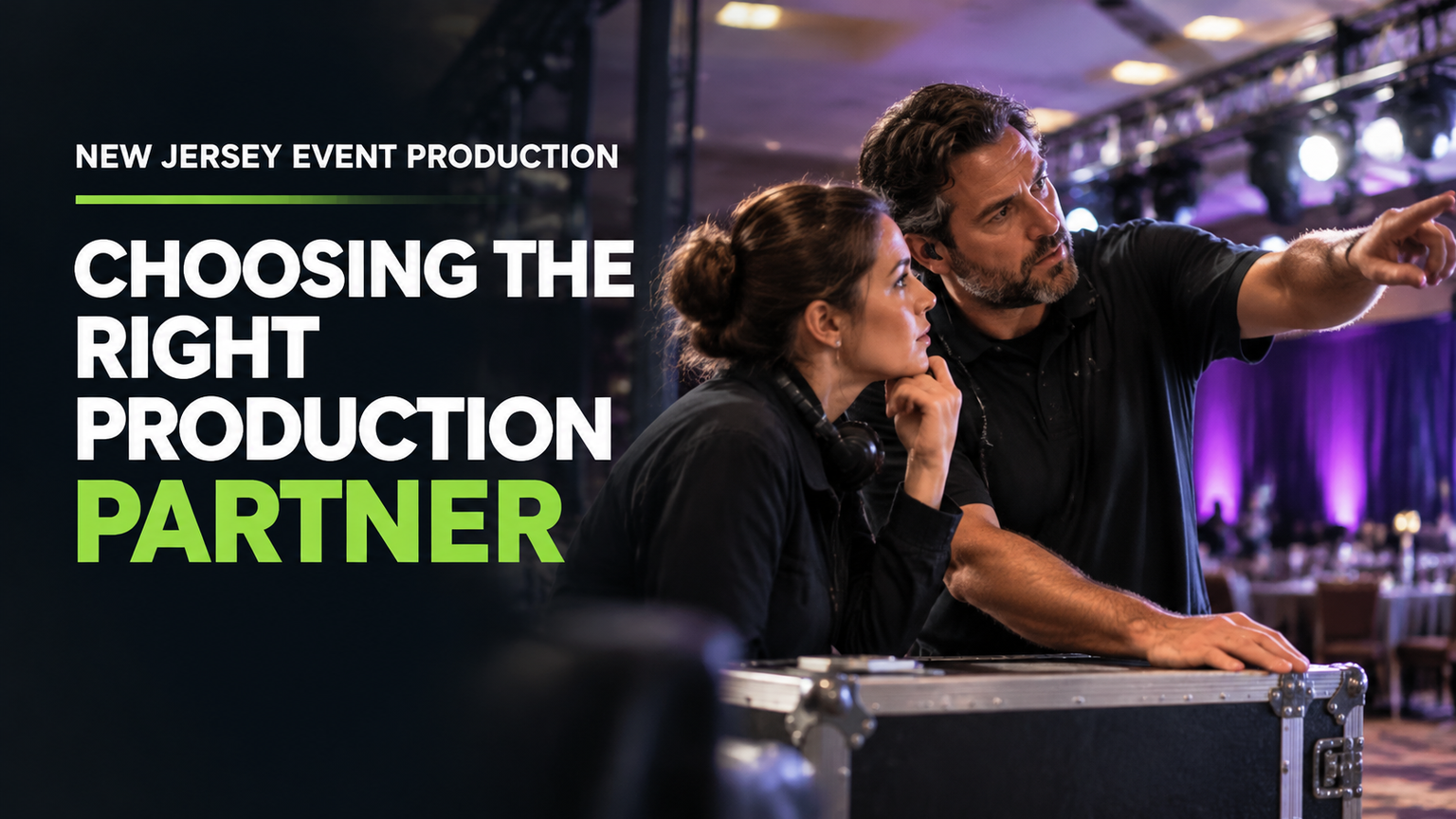
New Jersey Event Production: How to Choose the Right AV and Production Partner
Quick Answer
New Jersey event production includes audiovisual equipment, technical crews, lighting, staging, video, livestreaming, and production management. The right supplier depends on your event's requirements and who will take responsibility for delivering each service. Before booking, compare equipment, operators, regional coverage, venue coordination, permits, insurance, and the complete production cost—not just the initial quotation.
Key Takeaways
- New Jersey has several types of production suppliers, from full-service companies to specialist AV rental and technical staffing businesses.
- Equipment rental does not automatically include installation, operation, or troubleshooting.
- Confirm whether a supplier serves your specific New Jersey location and venue.
- Ask for separate prices covering equipment, labor, management, transportation, setup, and strike.
- Temporary structures may involve different New Jersey fire and construction permit requirements.
- Compare suppliers against the same event specification rather than relying on headline prices.
- AV Labor Source advertises nationwide AV staffing, but its specific New Jersey availability must be confirmed directly.
What Does New Jersey Event Production Include?
Event production brings together the technical equipment, people, and coordination needed to deliver an event as planned. For a corporate conference, product launch, awards ceremony, fundraising gala, or business meeting, this can involve much more than setting up microphones and a screen.
The actual requirements depend on the event format, venue, audience, and programme.
Audio production covers microphones, speakers, mixing consoles, wireless systems, playback, and sound engineering. A presentation with several speakers may need a different setup from a panel discussion or a large conference with multiple rooms.
Video and display production can include projection, LED walls, presentation screens, cameras, video switching, and playback systems. The supplier should explain who prepares the content, connects the equipment, tests the display, and operates it during the programme.
Lighting production includes stage lighting, room illumination, presentation lighting, and programmed effects. The technical requirements depend on whether the event is a business meeting, a gala, or a live performance.
Staging and rigging cover stage structures, platforms, suspended equipment, trussing, and installation. These services require particular attention to venue permissions, structural requirements, and qualified installation responsibilities.
Livestreaming and broadcast production can involve cameras, audio feeds, video switching, encoding, internet connectivity, recording, and remote audience delivery.
Technical management connects these services. A production manager or designated technical lead coordinates equipment, personnel, schedules, rehearsals, and communication with the venue.
The important distinction is between having equipment available and having a team responsible for delivering the complete technical service. A quotation that includes an LED wall but excludes installation, programming, and an operator may not provide everything your event needs.
For a closer look at the technical roles involved, see the AV Labor Source homepage, which describes its audiovisual staffing services.
Which Type of Event Production Company Do You Need?
Not every event production supplier operates in the same way. Some provide complete production management, while others concentrate on equipment, technical professionals, broadcasting, or scenic construction.
Understanding these differences helps prevent gaps between suppliers.
Full-service event production companies
A full-service production company may coordinate technical planning, equipment, staffing, installation, show operation, and removal. Some also provide creative planning and event management.
This model can be useful when an organization wants one primary production partner rather than managing several separate contractors.
However, the term full-service is not a standardized guarantee. Ask which services are included, which are subcontracted, and who remains accountable if something goes wrong.
HB Live, for example, publicly describes event production, audiovisual services, planning, and staffing, with a stated Northern New Jersey regional emphasis.
AV equipment rental and production specialists
An AV rental supplier may provide microphones, speakers, projectors, displays, LED walls, lighting equipment, and related accessories.
Some suppliers also provide technicians and production management. Others primarily supply equipment and delivery.
Atlantic Media Productions publicly describes services covering professional audio, video, projection, LED displays, event lighting, staging, rigging, streaming, and technical support.
When comparing this type of supplier, establish whether the quotation includes delivery, installation, testing, live operation, and removal.
Technical staffing providers
Technical staffing businesses concentrate on the people needed to operate production systems. Their professionals may include audio engineers, lighting technicians, video engineers, camera operators, LED technicians, and stagehands.
This model can suit an event agency or organization that already has access to equipment but needs experienced operators.
North East AV Crew publicly presents event staffing, equipment rental, installations, and specialist technical roles.
A staffing supplier should identify the positions being provided, working hours, reporting arrangements, overtime terms, and replacement procedures.
Live broadcast and streaming specialists
Some events require more than a traditional in-person AV setup. Government meetings, conferences, corporate presentations, and hybrid events may need multi-camera production and remote audience delivery.
AVP.Live presents live production and broadcasting services, including corporate events, government meetings, conferences, and livestreaming.
For this model, confirm camera coverage, switching, audio integration, internet arrangements, recording, and what happens if connectivity fails.
Scenic fabrication and custom staging providers
Scenic production involves creating physical structures and visual environments for events. This may include custom stages, branded structures, signage, dimensional displays, and installation logistics.
Creative Scenic Associates describes scenic fabrication, custom stages, signage, structures, and installation services associated with its New Jersey operation.
This specialist can complement an AV production supplier, but the two businesses should agree on installation schedules, measurements, power access, and responsibility for integrating their work.
Combined production, rental, and event management
Some companies combine several service categories. KD Productions & Events, based in Newfield, New Jersey, publicly describes audiovisual production, equipment rental, staffing, scenic services, and event management.
Showbox also presents a range of audiovisual production and rental services, including audio, video, lighting, staging, and hybrid production.
These examples illustrate different publicly advertised business models. They are not independent assessments of service quality, availability, pricing, or customer satisfaction. Contact each supplier to confirm its current capabilities and suitability for your event.
What Should a New Jersey Event Production Quote Include?
A useful production quotation should describe both the equipment and the people responsible for delivering the service.
A list of equipment models alone is not enough. The buyer needs to understand what happens before the event, during the programme, and after the audience leaves.
Audio and microphone requirements
Ask the supplier to specify:
- The number and types of microphones.
- Wireless frequency coordination where applicable.
- Speakers and audio coverage.
- Mixing console and sound engineer.
- Playback equipment and presentation audio connections.
- Backup microphones and critical equipment.
- Setup, testing, and live-operation responsibilities.
For example, a conference with six speakers and a question-and-answer session needs a different microphone plan from a presentation with one presenter.
Video, projection, and LED displays
Clarify:
- Screen or LED display dimensions.
- Projector specifications where projection is used.
- Camera requirements.
- Presentation computer and playback arrangements.
- Video switching and graphics operation.
- Content-format and resolution requirements.
- Backup playback equipment.
Ask who receives presentation files, checks them before the event, and operates the content during the programme.
Lighting and staging
Lighting and stage requirements should be described in practical terms.
Confirm the lighting design, fixtures, programming, operator, stage dimensions, installation arrangements, and any rigging responsibilities. If equipment is suspended or attached to venue structures, establish who handles engineering documentation and approvals where required.
Technical personnel and production management
A quotation should identify the technical positions rather than simply state that a crew is included.
For example, an event may require separate audio, lighting, video, camera, graphics, and general technical personnel.
It should also identify the person responsible for coordinating the overall production and communicating with the venue and event organizer.
The AV Technician Staffing Guide for Events provides a more detailed resource on technical staffing roles and event crew requirements.
Setup, operation, and removal
Production costs can be affected by the amount of time required to install and remove equipment.
Request a schedule showing:
- Venue access and load-in.
- Equipment installation.
- Technical testing and troubleshooting.
- Rehearsal and programme preparation.
- Live event operation.
- Equipment removal and venue handover.
Confirm whether the quotation includes all these stages. A supplier may price the event itself but charge separately for early access, additional rehearsal time, or late-night removal.
How Does New Jersey Location and Venue Coordination Affect Your Choice?
A production company may advertise regional or nationwide services without necessarily having the same staffing arrangements in every location.
For New Jersey events, confirm the actual service area rather than relying on a nearby office or a general statement about regional coverage.
Check Northern, Central, and Southern New Jersey coverage
Ask prospective suppliers whether they can fulfill your event at its exact venue and address.
Your questions should include:
- Can the supplier provide the required technicians at this location?
- Does the supplier transport equipment directly or use a local rental partner?
- Are travel, accommodation, and transportation included?
- Are additional charges applicable outside its normal service area?
- Can the supplier provide a local site visit before the event?
- Who is the local contact responsible for the installation?
A company serving Northern New Jersey should not automatically be assumed to offer identical arrangements throughout Central and Southern New Jersey.
Coordinate with the venue before signing
Even an experienced production company must work within the venue's operating conditions.
Request information about:
- Loading docks and equipment access.
- Freight elevators and movement restrictions.
- Permitted installation and removal hours.
- Available electrical circuits and power capacity.
- House AV equipment and compatibility.
- Ceiling heights and rigging restrictions.
- Noise limitations.
- Insurance certificates and vendor requirements.
- Storage space and equipment security.
A venue site visit can help identify problems that may not be apparent from photographs or a floor plan.
For example, a production supplier may quote an LED wall based on available floor space, only to discover that the venue has restricted installation access or insufficient structural clearance. Resolving these questions before booking can prevent expensive changes.
Distinguish neighboring market coverage
AV Labor Source has a published New York City AV technician service page. Its homepage describes nationwide audiovisual staffing and identifies a Las Vegas base.
These details establish the company's stated service positioning, but a New York City location page does not prove that it has a dedicated New Jersey office or guaranteed staffing availability throughout the state.
Organizations considering AV Labor Source should directly confirm New Jersey fulfillment, travel arrangements, equipment responsibilities, and venue documentation before making a booking.
Which New Jersey Permits and Temporary-Structure Rules Should You Check?
Outdoor events, temporary stages, tents, canopies, and other structures can introduce additional compliance requirements.
New Jersey's requirements should not be reduced to a single rule that applies to every event. The relevant permits depend on the structure, its dimensions, use, location, and circumstances.
Understand fire and construction permit requirements
The New Jersey Department of Community Affairs publishes official tent permit guidelines.
The guidance distinguishes between requirements under the Uniform Fire Code and the Uniform Construction Code. It identifies considerations such as:
- The area and maximum dimensions of the structure.
- How long the structure will remain in place.
- The season and circumstances of its use.
- Anchoring arrangements.
- Platforms, stages, or bleachers associated with the structure.
The New Jersey Uniform Construction Code regulations also address construction permit requirements involving temporary structures and tents.
Because the applicable rules depend on the project, ask the relevant municipal construction official and fire official to confirm the requirements for your specific event.
You can also consult the state's current construction-code information when checking applicable regulations.
Check municipal event permissions
State requirements are not the only consideration. Municipalities and individual venues may have separate application procedures.
For example, the Town of Morristown facilities-use guidance illustrates how facility use can involve separate considerations relating to fire safety, food, construction, and electrical work.
This is a municipal example, not a universal checklist for every New Jersey town.
Before finalizing a production plan, identify the municipality, venue, event type, and structures involved. Ask which applications, inspections, and approvals apply.
Coordinate responsibilities with the production supplier
The supplier should explain which compliance-related tasks it handles and which remain the organizer's responsibility.
Ask for written confirmation of:
- Who submits or coordinates applicable permit applications.
- Who supplies technical or structural documentation.
- Who handles stage, truss, and equipment installation.
- Whether the venue requires insurance certificates.
- Who coordinates inspections and access with local officials.
- Who is responsible for any subcontracted installation work.
The New Jersey Division of Fire Safety also publishes cooking vendor, tent, and canopy guidance. This document is dated November 2014, so treat it as historical supporting guidance and verify current requirements before relying on individual provisions.
How to Compare Event Production Companies Before Booking
Comparing three suppliers is much easier when they receive the same event brief and answer the same questions.
A lower quotation may reflect a smaller scope rather than better value. One company may include technicians and production management, while another supplies only equipment and delivery.
The following worksheet provides a practical way to compare proposals.
New Jersey Event Production Supplier Comparison Worksheet
| Comparison field | Supplier A | Supplier B | Supplier C |
|---|---|---|---|
| Supplier model | |||
| Confirmed New Jersey coverage | |||
| Travel and transportation | |||
| Equipment ownership or rental | |||
| Audio equipment and operation | |||
| Video and display services | |||
| Lighting design and operation | |||
| Staging and rigging | |||
| Livestreaming and recording | |||
| Technical staffing | |||
| Production management | |||
| Venue coordination | |||
| Permits and documentation | |||
| Insurance certificates | |||
| Installation and testing | |||
| Live show operation | |||
| Strike and removal | |||
| Backup arrangements | |||
| Subcontractors | |||
| Base production cost | |||
| Optional enhancements | |||
| Additional charges and exclusions | |||
| Cancellation and overtime terms |
Complete the table using written quotations rather than assumptions. If a supplier cannot confirm an item, mark it as unconfirmed instead of treating it as included.
Normalize the total production cost
Use the same cost categories for every proposal:
Comparable event cost = equipment + technical labor + production management + transportation + installation + show operation + strike + approved additional services.
This is a comparison framework, not an established New Jersey industry pricing formula.
Ask every supplier to separate its proposal into three totals:
- Base production cost: The services and equipment required to deliver the agreed event specification.
- Optional enhancements: Additional screens, cameras, lighting effects, recording, or other improvements.
- Potential additional charges: Overtime, travel, accommodation, additional technicians, venue access changes, and services excluded from the base price.
This approach makes it easier to identify differences in scope before comparing the financial proposals.
An illustrative supplier comparison
Imagine an organization planning a corporate conference in New Jersey and requesting proposals from three production companies.
- Supplier A offers audiovisual equipment and delivery but excludes operators.
- Supplier B includes equipment, specialist technicians, and show management.
- Supplier C offers a complete production package but uses subcontractors for selected technical positions.
These are hypothetical supplier profiles, not actual company quotations.
Supplier A may have the lowest initial price, but the organizer still needs to arrange qualified operators. Supplier B provides a more clearly defined technical service. Supplier C may simplify purchasing, but the organizer should understand subcontracting arrangements and accountability.
The correct comparison is not simply which proposal has the lowest headline figure. It is which supplier delivers the required scope with clear responsibilities, acceptable commercial terms, and appropriate contingency arrangements.
What Should You Verify About AV Labor Source?
AV Labor Source describes itself as a nationwide audiovisual staffing provider for corporate events and live productions.
Its published website identifies technical capabilities and professional roles including:
- AV technicians and general technical personnel.
- Audio engineers.
- Lighting engineers and designers.
- Video and LED technicians.
- Graphics and computer playback technicians.
- Camera operators.
- On-site show management.
These services may be relevant when an event organizer, production agency, or AV company needs additional technical professionals.
However, audiovisual staffing and full-service event production are not interchangeable. A staffing provider may supply the technicians responsible for operating equipment without supplying every piece of equipment, managing the entire event, or assuming responsibility for all production activities.
Before requesting a New Jersey proposal, confirm:
- Whether the company currently accepts New Jersey event staffing requests.
- Which parts of New Jersey it can serve.
- Which technical positions are available for your event dates.
- Whether equipment is supplied or must be arranged separately.
- Whether a production manager or show caller is included.
- Whether travel and accommodation affect the quotation.
- Whether the company can provide the insurance documentation required by your venue.
- Whether backup personnel and replacement arrangements are available.
The company's homepage provides its published service positioning. Its New York City location page is useful regional context, but does not establish a dedicated New Jersey operation.
A direct confirmation is essential before presenting New Jersey availability as a guaranteed service.
Frequently Asked Questions
What is included in New Jersey event production?
It can include audio, video, projection, LED displays, lighting, staging, rigging, livestreaming, technical staffing, and production management. The exact scope depends on the event and supplier. Always confirm which services include equipment, installation, operators, and removal.
How much does event production cost in New Jersey?
There is no verified, comparable statewide production price established by the reviewed supplier information. Costs depend on equipment, technical labor, event duration, venue requirements, transportation, and production complexity. Request itemized quotations using the same event brief.
What is the difference between AV rental and full-service production?
AV rental primarily concerns supplying audiovisual equipment, although some rental companies also provide technicians. Full-service production generally involves a broader combination of equipment, technical labor, management, coordination, and show delivery. Confirm the actual contract scope rather than relying on the service label.
Should I hire production technicians separately?
It depends on the supplier's scope and your existing arrangements. If your organization or venue already has equipment, a technical staffing provider may supply the necessary operators. If you need equipment, technicians, and coordinated production management, a broader production package may be more suitable.
Do New Jersey event tents and temporary structures require permits?
Some temporary structures require permits under applicable fire or construction regulations. Requirements depend on the structure and its circumstances. Consult the New Jersey Department of Community Affairs guidance and confirm the specific requirements with the relevant municipal officials.
How far in advance should I contact production suppliers?
There is no verified universal lead time for every New Jersey event. Contact suppliers early enough to confirm equipment, technical personnel, venue access, site visits, and applicable approvals. Complex staging, rigging, or outdoor installations may require additional coordination.
Can an audiovisual staffing company manage an entire event?
Not necessarily. An audiovisual staffing company may provide technicians and technical specialists without supplying equipment or taking responsibility for complete event management. Ask whether the agreement includes production management, equipment, venue coordination, installation, operation, and strike.
Choosing the Right New Jersey Event Production Partner
Successful New Jersey event production begins with a clearly defined purchasing decision. Determine whether you need a full-service production company, AV equipment supplier, technical staffing provider, broadcast specialist, or scenic production partner.
Then check the supplier's actual regional coverage, technical responsibilities, venue arrangements, compliance requirements, and complete commercial terms.
The most useful quotation is not necessarily the cheapest one. It is the proposal that clearly explains what will be delivered, who is responsible for every important task, and what additional costs could arise.
Use the same event specification and comparison worksheet for every supplier. Confirm local requirements before approving temporary structures or technical installations, and obtain written confirmation of service availability before making a booking.
With these checks in place, you can approach New Jersey event production with a clearer understanding of the services you are purchasing and a stronger basis for choosing the right production partner.