





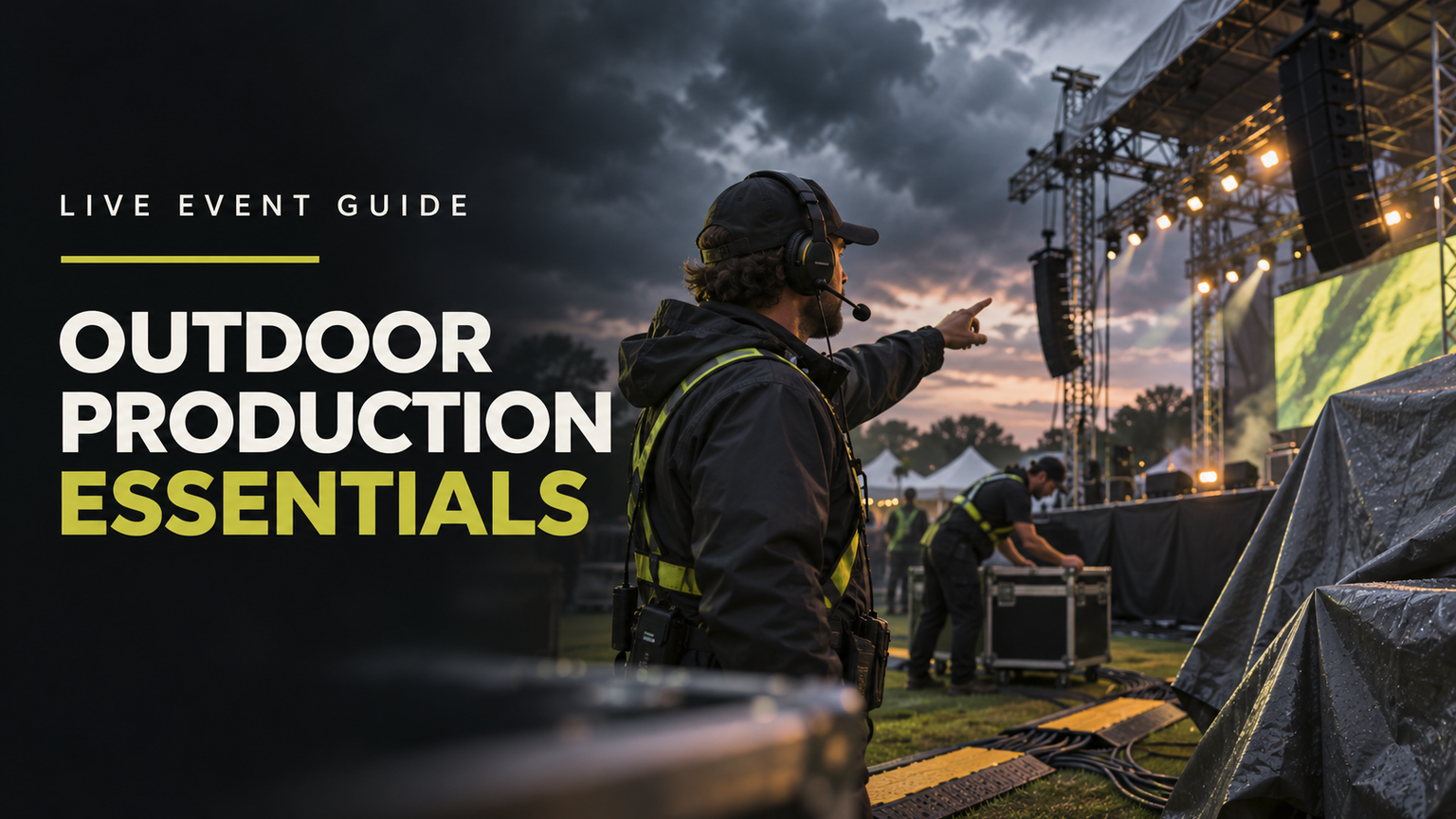
Published on November 10, 2026
Outdoor Event Production: Planning, Equipment, Crew, and Weather Safety
Quick Answer
Outdoor event production brings together staging, audio, lighting, video, temporary power, technical crews, and show operations to deliver a successful event in an open-air environment. Unlike indoor events, outdoor productions must account for changing weather, wind, rain, heat, daylight, ground conditions, and limited infrastructure. The safest approach starts with a detailed site assessment, qualified technical specialists, clear responsibilities, and a documented weather and emergency plan.
Key Takeaways
- Begin with a site survey rather than an equipment shopping list.
- Plan staging, sound, lighting, and video around the actual outdoor environment.
- Have qualified professionals assess temporary electrical distribution and generator arrangements.
- Establish weather monitoring, stop-work authority, evacuation arrangements, and safe shelter before the event.
- Schedule technicians according to their responsibilities, working hours, and supervision requirements—not attendance alone.
- Compare equipment-only, technical labor-only, and integrated production proposals carefully.
- Confirm exactly who is responsible for engineering, permits, installation, operation, and emergency decisions.
What Outdoor Event Production Actually Includes
Outdoor events can look straightforward from the audience's perspective. A stage, a few microphones, large displays, attractive lighting, and an organized program may appear to be all that is needed.
Behind the scenes, however, these elements depend on several connected technical and operational systems. Each must work in an environment that may have no permanent electrical infrastructure, no protected equipment positions, and no predictable acoustic conditions.
A typical outdoor event production operation can involve:
- Stage and infrastructure coordination: Temporary stages, platforms, towers, tents, access points, and equipment positions.
- Audio production: Microphones, mixing systems, speakers, monitoring, and audience sound coverage.
- Lighting production: Stage lighting, architectural illumination, work lighting, and evening visibility.
- Video production: LED displays, presentation screens, cameras, playback systems, and signal distribution.
- Temporary power: Electrical distribution, generator coordination, protective equipment, and cable management.
- Technical labor: Audio engineers, lighting engineers, video technicians, camera operators, stagehands, and technical supervisors.
- Show management: Rehearsals, technical cues, communications, troubleshooting, and coordination between departments.
- Load-out: Equipment removal, transportation, site restoration, and final checks.
Not every production provider supplies every service. Some companies provide technical personnel, while others supply equipment or coordinate multiple production disciplines.
This distinction matters when comparing proposals. A company providing experienced AV technicians is not automatically accepting responsibility for structural engineering, electrical installation, generator supply, permits, or overall event safety.
For example, AV Labor Source describes audio engineers, lighting engineers, video and LED technicians, camera operators, technical support, show management, and stagehands for outdoor events among its published capabilities. These descriptions establish its stated staffing services, not a verified turnkey outdoor production package.
Start With the Outdoor Site, Not the Equipment List
The venue determines many of the technical decisions that follow. Choosing equipment before understanding the site can lead to poor sound coverage, unsuitable screen placement, installation delays, and expensive last-minute changes.
A proper site assessment should establish the following.
Ground conditions and installation areas
Identify where stages, towers, tents, generators, cable routes, control positions, and audience facilities can safely be located.
Check the ground for uneven surfaces, slopes, soft soil, drainage problems, and other conditions that could affect temporary structures or equipment access.
Do not assume that a location suitable for ordinary pedestrian use is automatically suitable for a temporary stage, vehicle, generator, or anchored structure.
Structural suppliers and appropriately qualified professionals should determine what installation arrangements are suitable for the actual ground conditions.
Audience layout and viewing positions
Attendance is only one part of the site calculation. The shape and distribution of the audience also affect technical requirements.
Consider:
- The distance between the stage and the furthest audience members.
- Audience width and depth.
- Whether people will be standing, seated, or moving between areas.
- Sightlines to the stage and displays.
- Accessible viewing positions and routes.
- Emergency exits and circulation paths.
- The positions of technical control areas.
A compact audience gathered in front of a stage presents different production requirements from a widely distributed festival audience.
The same attendance figure can therefore require substantially different audio, video, and infrastructure designs.
Site access and production schedules
A technically suitable venue can still create operational difficulties if delivery vehicles cannot reach the installation area or the crew has insufficient setup time.
Confirm:
- Delivery vehicle restrictions and loading access.
- Equipment movement routes.
- Available installation and rehearsal windows.
- Restrictions on vehicle movement during public opening hours.
- Storage and security arrangements.
- Power distribution routes.
- Removal deadlines and site handback requirements.
Include setup, testing, rehearsal, show operation, and removal in the production schedule. A quotation that covers only the performance period may not reflect the actual labor required.
Weather exposure and surrounding properties
Assess the site's exposure to wind, rain, direct sunlight, heat, and changing temperatures.
Nearby buildings, trees, roads, residential properties, and other activities may also influence sound placement, lighting, audience movement, and operating restrictions.
Record the venue's restrictions and identify who will verify any required approvals before installation begins.
Sound, Lighting, Video, and Staging Need Different Outdoor Decisions
Outdoor AV design cannot simply copy an indoor equipment arrangement and move it outside. Each production discipline faces different environmental conditions.
Outdoor audio and sound coverage
Indoor venues often provide walls, ceilings, and other surfaces that reflect sound. Open-air locations lack many of these boundaries, changing how sound travels through the audience area.
Wind, stage orientation, nearby buildings, surrounding noise, and audience geometry can all influence the result.
An effective audio plan should establish:
- The intended audience coverage area.
- The distance between the stage and audience positions.
- The required speech intelligibility and music coverage.
- The location of microphones, speakers, and monitoring systems.
- The impact of surrounding noise and local sound restrictions.
- The position of the audio control area.
- The arrangements for testing and troubleshooting.
The audio system designer should select and position equipment based on the actual site and performance requirements.
There is no universally reliable speaker count based only on attendance. Two events with identical audience numbers may need different systems because their layouts and sound objectives differ.
The Mixmode event production guide also discusses outdoor power, sound considerations, and weather contingencies. It is useful supplementary industry commentary, rather than an engineering or regulatory authority.
Stage lighting and changing daylight
Outdoor lighting requirements change throughout the day.
A daytime presentation may rely heavily on natural light, while an evening concert needs carefully designed stage illumination and sufficient working light for technical personnel.
The lighting plan should consider:
- Natural daylight and sunset timing.
- Stage orientation and surrounding light sources.
- Performer visibility.
- Audience-facing lighting and glare.
- Safe backstage and equipment access.
- Power availability and distribution.
- Weather exposure and equipment suitability.
A useful approach is to review the event's full operating schedule rather than design lighting around a single performance moment.
For a program that begins in the afternoon and finishes after sunset, lighting requirements may change considerably during the event.
LED screens and outdoor video
Displays that look clear indoors may become difficult to see in direct sunlight.
Outdoor video planning should account for ambient light, screen technology, viewing distance, screen placement, weather suitability, and the type of content being displayed.
Ask the video specialist to evaluate:
- Whether the screen is suitable for its intended environment.
- Whether important content remains readable in daylight.
- The viewing positions of the audience.
- Camera and presentation signal requirements.
- Playback and backup arrangements.
- Equipment protection and cable routing.
Do not select a display using a brightness figure alone. Visibility depends on the screen, surrounding light, content, placement, and viewing conditions.
Temporary stages, towers, and rigging
Temporary structures require their own planning and responsibility arrangements.
A stage, lighting tower, suspended display, or temporary roof must be suitable for the intended configuration and environmental conditions.
Confirm who supplies the structural design, installation procedures, anchoring arrangements, inspections, and any required engineering documentation.
Wind exposure deserves particular attention because equipment and structures that appear stable under ordinary conditions may become unsafe when environmental conditions change.
The relevant manufacturer instructions, qualified professionals, venue rules, and local approval requirements should determine acceptable configurations and operating limits.
Do not assume that a tent, stage roof, or equipment cover automatically makes a production area safe during severe weather.
Temporary Power and Infrastructure Must Be Verified
Temporary electrical infrastructure is one of the most important parts of outdoor event production.
Indoor venues often have established electrical systems and designated connection points. Outdoor sites may require temporary distribution, generators, additional protective equipment, and carefully planned cable routes.
An electrical problem can interrupt the show, damage equipment, or create serious safety hazards.
Prepare an electrical load schedule
Start by identifying the electrical requirements of the planned production systems.
The load schedule should account for relevant equipment, including:
- Audio systems and amplifiers.
- Lighting fixtures and control systems.
- LED displays and video equipment.
- Cameras and production control equipment.
- Communications systems.
- Other event infrastructure connected to the temporary supply.
The qualified electrical lead should use actual equipment specifications and operating requirements to assess the proposed supply and distribution design.
Avoid selecting generator capacity through a simple attendance-based estimate or an unsupported rule of thumb.
Confirm electrical protection and distribution
The electrical plan should identify:
- Available electrical supply and connection arrangements.
- Calculated loads and distribution requirements.
- Appropriate protective devices.
- Grounding and bonding arrangements.
- Cable routing and physical protection.
- Equipment suitability for outdoor exposure.
- Inspection and testing responsibilities.
- Backup arrangements and procedures for electrical faults.
A ground-fault circuit interrupter, commonly called a GFCI, is a protective device designed to interrupt a circuit when it detects certain dangerous electrical leakage conditions.
OSHA explains GFCI functions and relevant electrical hazards in its ground-fault circuit interrupter guidance.
The equipment and protection must be appropriate to the actual application and exposure. A GFCI does not replace correct electrical design, installation, inspection, or other protective measures.
OSHA's construction electrical standard, 29 CFR 1926.404, contains requirements for defined construction-site circumstances. Its provisions should not be presented as automatically governing every type of outdoor event. Confirm the applicable legal requirements for the actual worksite and activities.
Generator placement and operation
If generators are needed, their placement and operation require qualified planning.
Consider fuel handling, access control, exhaust, ventilation, fire risks, noise, environmental exposure, and the relationship between generators and public areas.
Portable generators can introduce electrical, fire, and carbon monoxide hazards. Carbon monoxide is a dangerous gas produced by fuel-burning equipment.
The generator supplier and qualified electrical personnel should establish the appropriate operating arrangements, including the location, distribution system, fuel procedures, and contingency plan.
Never treat an ordinary enclosed or partially enclosed event space as an appropriate generator operating location without professional assessment.
Weather, Lightning, and Crew Safety Must Have Named Owners
Weather is not simply an inconvenience for outdoor event production. It can change whether the event can safely continue.
A rain plan alone is insufficient. The production team needs a documented process for monitoring conditions, communicating warnings, stopping work, protecting people, and determining whether operations can resume.
Establish a weather-monitoring procedure
Before the event, identify:
- Who monitors official weather information.
- Who receives weather alerts.
- Which person has authority to pause or stop the event.
- How the venue, production crew, security, and organizers communicate.
- Where attendees and workers should go during an emergency.
- How evacuation or shelter instructions will be delivered.
- Who authorizes the eventual restart.
The National Weather Service lightning safety guidance recommends that organized outdoor activities have a lightning safety plan.
This plan should define monitoring, stopping activities, safe shelter, emergency response, and resumption procedures.
Understand lightning shelter requirements
One important distinction is the difference between protecting equipment from rain and protecting people from lightning.
An ordinary tent or open-sided shelter does not provide adequate lightning protection.
The National Weather Service identifies substantial buildings and enclosed hard-topped vehicles as appropriate shelter options. Its outdoor lightning shelter guidance explains why small open structures and ordinary rain shelters are unsuitable.
A covered stage may protect some equipment from precipitation, but it should never be treated as a safe lightning refuge.
The National Weather Service recommends waiting at least 30 minutes after the last thunder before returning to outdoor activities. See its lightning safety tips.
That interval is not automatic permission to restart. Wind, flooding, structural conditions, and other hazards may still make reopening unsafe. The event's responsible safety personnel must assess the complete situation.
Protect crews from heat exposure
Outdoor production crews can spend long periods moving heavy equipment, installing temporary structures, working in direct sunlight, and operating technical systems.
Heat exposure can affect both safety and performance.
The production schedule should therefore account for water availability, recovery areas, workload, acclimatization, and appropriate rest arrangements.
OSHA's heat exposure controls recommend measures such as water, rest, cooler recovery locations, training, and adjustments to work schedules and workloads.
Its water, rest, and shade guidance provides additional practical information.
For production managers, this means planning crew calls around actual working conditions rather than assuming that technicians can maintain the same workload throughout a long outdoor installation.
A responsible schedule should consider:
- Installation and removal workloads.
- Direct sunlight and available shade.
- Access to drinking water.
- Appropriate recovery periods.
- Crew acclimatization.
- Shift duration and supervision.
- Procedures for recognizing and responding to heat-related illness.
Do not rely on one universal temperature threshold or fixed break schedule to determine whether work is safe. Conditions and applicable requirements vary.
Build the Right Technical Crew and Responsibility Structure
An outdoor production crew needs clearly defined technical responsibilities.
Requesting a certain number of technicians without identifying their specialties can create staffing gaps, especially when several systems must be installed and operated simultaneously.
Understand the main technical positions
| Position | Main responsibility |
|---|---|
| A1 audio engineer | Directs the main audio system and mixing operation |
| A2 audio technician | Supports audio equipment, microphones, and related operations |
| Lighting engineer | Handles lighting system installation and operation |
| Video engineer | Manages video systems, displays, and signal-related operations |
| Camera operator | Operates cameras for the required production coverage |
| Stagehand | Supports equipment movement, setup, and other assigned stage or production tasks |
| Project manager | Coordinates production activities, schedules, and operational requirements |
| Crew lead | Provides designated supervision and coordinates technicians |
| Labor coordinator | Coordinates staffing movements and labor requirements |
These are practical role descriptions, not a universal certification system or nationally mandated staffing structure.
AV Labor Source publishes descriptions of these and related positions on its company website.
Its published guidance identifies a crew lead for crews of 12–19 technicians and a labor coordinator for crews of 20 or more, or by request. These are company-specific guidelines, not universal industry staffing regulations.
Determine staffing from the production scope
The required team depends on several factors:
- Number and complexity of technical systems.
- Installation and removal schedules.
- Whether equipment needs continuous operation.
- The number of separate production areas.
- Rehearsal and performance requirements.
- Technical supervision needs.
- Access restrictions and equipment movement.
- Working conditions and appropriate shift arrangements.
For example, an outdoor company launch might involve a temporary presentation stage, microphones, a daylight-readable display, evening lighting, and several technical departments.
Before deciding how many technicians to request, the organizer should confirm the equipment plan, installation window, power arrangements, show cues, rehearsal schedule, weather contingency, and supervisory responsibilities.
This is an illustrative scenario, not a reported client project or staffing recommendation.
Request location-specific technical support
Geographic availability and event-date availability should be confirmed directly with the staffing provider.
For buyers planning an event in Colorado, AV technicians in Denver is a relevant starting point for a location-specific technical labor inquiry.
The existence of a location page does not establish availability for a particular date or prove that every outdoor production discipline is supplied in that market.
Compare Outdoor Production Vendors Before Signing
Different production arrangements can use similar language while transferring very different responsibilities.
Understanding the contract model is therefore essential.
Equipment-only supply
An equipment-only provider supplies specified systems for the event.
The buyer may still need separate contractors for installation, electrical work, technical operation, supervision, and show management.
This arrangement can suit an organizer who already has an experienced production team and clearly assigned technical responsibilities.
Technical labor-only staffing
A technical labor provider supplies specified personnel, such as audio engineers, lighting technicians, video engineers, camera operators, or stagehands.
Equipment, engineering, permits, temporary power, and overall event responsibility may remain with the organizer or other contractors.
This arrangement can be useful when the production equipment and design are already established but additional qualified personnel are needed.
Integrated production coordination
An integrated production contractor may coordinate several disciplines, including equipment, technical labor, installation, and show operation.
However, a broader package name does not automatically establish that all engineering, structural, electrical, permitting, and public safety responsibilities are included.
Review the actual written scope and identify the responsible party for each requirement.
Compare the commercial scope, not just the headline price
Ask every supplier to identify the following items as INCLUDED, EXCLUDED, or SUBJECT TO CONFIRMATION.
| Quotation item | What to establish |
|---|---|
| Equipment rental | Exact systems, quantities, specifications, and rental period |
| Transportation | Delivery, collection, vehicle access, and travel charges |
| Installation | Setup responsibilities and installation schedule |
| Technical labor | Job titles, personnel numbers, hours, and specialties |
| Supervision | Crew leadership and departmental coordination |
| Engineering | Structural and electrical design responsibilities |
| Permits and approvals | Who obtains and verifies required permissions |
| Temporary power | Generator supply, distribution, fuel, and electrical oversight |
| Weather protection | Equipment protection and safe operating limitations |
| Rehearsals | Testing, technical checks, and rehearsal coverage |
| Show operation | Live technical operation and cue management |
| Standby and overtime | Additional hours, standby arrangements, and applicable charges |
| Cancellation | Weather-related cancellation and postponement terms |
| Load-out | Equipment removal, transportation, and site restoration |
A proposal should also identify assumptions and unresolved requirements. If a supplier has not confirmed a particular service, do not treat it as included.
There are no sufficiently verified universal outdoor production prices or national crew-size ratios to recommend here. Obtain comparable, site-specific quotations instead.
Outdoor Production Readiness and Responsibility Matrix
The following matrix is a practical buyer-side tool for reviewing outdoor event production before installation begins.
It connects each major decision with the evidence to request, the person or organization that should own it, and the consequences of leaving it unresolved.
| Decision area | Evidence to request | Accountable party to identify | Unresolved risk |
|---|---|---|---|
| Site and permits | Venue rules, site plan, applicable approvals | Organizer or venue lead | Unauthorized site use or installation |
| Stage and structures | Approved plans, rated configurations, installation and inspection procedures | Structure supplier and qualified responsible professional | Unsafe temporary structure |
| Electrical power | Load schedule, distribution design, protection, and generator plan | Qualified electrical lead | Supply failure, electrical shock, or fire |
| Weather response | Monitoring owner, hazard thresholds, shelter and evacuation plan | Event safety lead or incident command | Delayed protective action |
| Audio coverage | Audience geometry, sound objectives, and local sound limits | Audio system designer or A1 | Poor intelligibility or unwanted noise |
| Video and LED | Daylight evaluation, viewing positions, and weather suitability | Video lead and equipment supplier | Unreadable or unsuitable displays |
| Crew and supervision | Departmental labor call, responsibilities, shifts, and breaks | Production manager and staffing coordinator | Skills gaps, fatigue, or delays |
| Show operation | Run of show, cue ownership, communications, and backup procedures | Show caller or technical director | Uncoordinated cues and slow response |
| Accessibility and audience movement | Accessible routes, viewing provisions, facilities, and emergency egress | Organizer, venue, and access specialists | Exclusion or unsafe movement |
| Load-out and restoration | Vehicle access, removal schedule, waste, and site handback | Production logistics lead | Overtime, property damage, or site delays |
This matrix is an editorial planning framework, not an official government checklist, engineering certification, or substitute for site-specific professional assessments.
Separate safety gates from optional enhancements
Not every production decision has the same importance.
Some items are essential conditions that must be resolved before the event can proceed safely. Others improve the audience experience but may be adjusted without creating the same immediate safety consequences.
Safety and operational gates generally include:
- Required venue permissions and applicable approvals.
- Suitable structural arrangements and inspections.
- Qualified electrical oversight and appropriate protection.
- A workable weather, shelter, and evacuation plan.
- Accessible audience routes and safe emergency egress.
- Adequate technical supervision and safe crew arrangements.
- Clear authority to stop unsafe operations.
Production enhancements may include:
- Additional decorative lighting.
- Supplementary display screens.
- Optional camera angles.
- Enhanced visual effects.
- Additional audience-facing production features.
The distinction is not that enhancements are unimportant. It is that they should not take priority over unresolved safety and operational requirements.
If an essential gate remains unresolved, the responsible organizer and qualified specialists should determine whether installation or the event can proceed.
A Practical Timeline for Outdoor Production Preparation
A structured timeline helps connect decisions that otherwise tend to be handled separately.
The exact schedule depends on event size, venue requirements, contractor lead times, and installation complexity. The following sequence is a planning framework rather than a universal deadline.
Early planning: Establish the production requirements
- Define the event format and intended audience experience.
- Identify the venue and review its restrictions.
- Arrange an initial site assessment.
- Establish the required staging, audio, lighting, and video systems.
- Identify likely equipment and labor providers.
- Determine who is responsible for permits, engineering, and event safety.
Before technical installation: Confirm the design
- Finalize the site layout and equipment positions.
- Obtain the required structural documentation and approvals.
- Confirm temporary power and electrical distribution arrangements.
- Review audience circulation and accessibility.
- Agree on weather monitoring, shelter, and evacuation procedures.
- Confirm technical staffing specialties and supervision.
- Document the contract inclusions and exclusions.
Installation and rehearsal: Verify the systems
- Confirm delivery access and installation windows.
- Check that the approved installation arrangements are being followed.
- Have qualified personnel verify electrical systems before operation.
- Test audio coverage and communication systems.
- Check displays under actual viewing and lighting conditions.
- Test lighting cues and show playback.
- Confirm emergency communications and weather procedures.
- Conduct rehearsals and resolve technical issues before public opening.
During the event: Operate and monitor
- Maintain technical department communications.
- Monitor weather and site conditions.
- Follow the approved safety and stop-work procedures.
- Keep audience routes and emergency access clear.
- Monitor crew welfare and working conditions.
- Record and communicate technical issues.
After the event: Close out responsibly
- Follow the agreed equipment shutdown procedure.
- Coordinate safe equipment removal.
- Confirm that temporary infrastructure is removed appropriately.
- Restore the venue as agreed.
- Document damage, outstanding issues, and equipment returns.
- Review operational lessons for future productions.
Frequently Asked Questions
What does outdoor event production include?
It can include stage coordination, audio, lighting, video, temporary power, equipment installation, technical staffing, show management, and removal. The actual scope depends on the supplier agreements and responsibilities assigned to each contractor.
Why is outdoor event production more complicated than indoor production?
Outdoor events face weather exposure, changing daylight, different acoustic conditions, limited permanent infrastructure, and site-specific structural and electrical requirements. These factors influence equipment selection, installation, staffing, and emergency procedures.
Can an ordinary tent provide lightning protection?
No. Ordinary tents and open-sided shelters are not safe lightning refuges. The National Weather Service identifies substantial buildings and enclosed hard-topped vehicles as appropriate shelter options. See its outdoor lightning guidance.
Who decides when an outdoor event should stop because of weather?
The event's approved safety and operational plan should identify an empowered decision-maker, a weather-monitoring responsibility, and clear communication procedures. The venue, organizer, safety personnel, and production leaders should understand their respective responsibilities before the event begins.
How do I estimate the required AV crew?
Start with the actual equipment systems, installation and removal schedules, operating requirements, departmental specialties, supervision, rehearsal needs, and working conditions. Attendance alone cannot determine the appropriate technical headcount.
Does an outdoor production vendor automatically provide generators?
No. Generator supply, operation, fuel, temporary distribution, electrical oversight, and backup power must be confirmed explicitly in the written scope of work.
What should an outdoor production quotation include?
It should identify equipment, technical personnel and hours, transportation, installation, operation, supervision, engineering, permits, power, weather protection, rehearsals, standby, overtime, cancellation, and load-out. Every item should be clearly marked as included, excluded, or awaiting confirmation.
When should I hire technical labor instead of an integrated production company?
Technical labor may be appropriate when the equipment, production design, and other responsibilities are already arranged. An integrated provider may be more suitable when multiple production disciplines need coordination. In either case, confirm who retains responsibility for engineering, permissions, power, safety, and overall event decisions.
Final Thoughts: Make Outdoor Production Readiness a Shared Responsibility
Successful outdoor event production is not simply a matter of placing equipment on a stage and hiring enough technicians to operate it.
It depends on the relationship between the site, technical systems, infrastructure, qualified personnel, and operational decisions. Weather planning, temporary electrical arrangements, structural responsibilities, audience access, and crew welfare must be considered alongside sound, lighting, and video quality.
The most important step is to make responsibility visible before installation begins. A supplier may provide equipment, another contractor may provide technical labor, and a qualified specialist may oversee electrical or structural work. The organizer still needs to understand how those responsibilities connect and who has authority when conditions change.
Use the Outdoor Production Readiness and Responsibility Matrix during site visits, vendor meetings, and quotation reviews. Resolve the essential safety and operational gates first, then refine the audience experience and optional production enhancements.
For buyers who need additional technical personnel, AV Labor Source provides a starting point for reviewing published AV staffing capabilities. Its Denver AV technician page is one example of a location-specific inquiry destination. Confirm the required specialties, geographic coverage, event-date availability, and exact contractual scope directly with the company.
A well-prepared outdoor production is one in which every important system has been assessed, every critical responsibility has an owner, and the team knows what to do when the original plan needs to change.