





Audio Visual Production: Crew Roles, Technical Standards & a Show-Ready Preflight Framework
Audio visual production is the planning, setup, operation, and checking of the audio, video, lighting, presentation, camera, network, and communications systems used for a live event. Good production also depends on clear crew roles, technical documents, accessibility planning, wireless coordination, safe work practices, rehearsals, and backup plans. The exact crew and systems depend on the venue, event format, room count, technical load, and cost of a failure. This guide focuses on the U.S. market.
Key Takeaways
- AV production is more than renting equipment. It joins people, systems, planning, operation, and show control.
- Crew titles matter because they define ownership. Audio, video, lighting, playback, cameras, networking, and show calling need clear leads.
- Laws, technical standards, and production best practices are not the same thing. They should never be presented as if they carry equal legal weight.
- Accessibility and worker noise exposure include measurable requirements that can affect event planning.
- Modern AV systems often run on IP networks, so networking knowledge now overlaps with traditional audio and video work.
- A system should be checked department by department before doors open. Powering it on is not the same as proving it is show-ready.
What Is Audio Visual Production?
Audio visual production turns a program plan into a working technical environment.
That may include speech reinforcement, music, presentation playback, cameras, projection, LED displays, lighting, recording, streaming, show communications, and networked media. The work begins before equipment reaches the room.
A simple way to separate common service models is this:
Service model | Main role |
AV equipment rental | Supplies equipment for the event. |
AV labor or staffing | Supplies skilled technical people. |
AV production | Coordinates technical systems, people, setup, operation, and show execution. |
Full-service event production | May also include scenic, staging, creative, content, and related event services. |
A strong production plan answers basic questions early. Who owns audio? Who owns video? Who loads and checks presentation files? Who manages wireless microphones? Who calls cues? Who has authority to change a technical plan during rehearsal?
If those answers are vague, problems tend to move downstream. They often appear during load-in, rehearsal, or the show itself.
For planners who need technical staffing rather than an undefined “AV crew,” AV Labor Source's AV technician and production roles provide a useful starting taxonomy.
Who Does What on an AV Production Crew?
Titles vary between companies and events. Still, clear job ownership is essential.
AV Labor Source publishes role descriptions for audio, video, lighting, graphics, camera, and production-management positions. Those descriptions make it easier to translate an event plan into actual technical work.
Audio roles
An A1 leads the audio system. AV Labor Source describes the role as directing setup, tuning, operation, and strike.
An A2 supports the A1. That work may include wireless microphones, line arrays, cables, and intercom systems.
A Show A2 has a more show-facing role. AV Labor Source describes duties that include wireless-microphone frequency work and direct interaction with presenters.
That distinction matters on microphone-heavy events. A general session with many presenters can create constant movement between backstage, stage entrances, microphones, batteries, frequency plans, and the console.
Video and presentation roles
A V1 directs configuration and operation of the video system.
A V2 supports video work such as screens, projection, monitors, cameras, playback, and recording systems.
Other events may also use dedicated projection, LED, playback, graphics, or camera positions. The more complex the content path becomes, the less useful it is to describe everyone simply as a “video tech.”
Lighting roles
Lighting crews may include an LD, L1, L2, or master electrician.
Their exact duties depend on the show and employer. A large production can split design, programming, power, fixture work, and show operation across several people.
Production leadership
Technical production may also use:
- A Technical Director who coordinates technical departments.
- A Project Manager who manages broader delivery and project needs.
- A Labor Coordinator who manages crew logistics.
- A Crew Lead who directs a working crew on site.
AV Crew and Handoff Matrix
Role | Before load-in | Setup/configuration | Rehearsal | Show | Main handoff |
A1 | Reviews audio needs. | Leads audio setup and tuning. | Checks sources, mics, and cues. | Operates or leads audio. | A2, Show A2, playback, TD. |
A2 / Show A2 | Reviews mic and support needs. | Builds and checks audio support systems. | Fits, checks, and tracks wireless mics. | Supports presenters and wireless flow. | A1, stage team, presenters. |
V1 | Reviews video paths and destinations. | Leads system setup and routing. | Checks switching and feeds. | Leads video operation. | V2, cameras, playback, TD. |
V2 | Reviews support needs. | Assists with displays, cameras, record, and projection. | Tests assigned paths. | Supports live operation. | V1 and related video roles. |
GFX / playback | Reviews show files. | Loads and checks playback systems. | Confirms cues and output. | Runs assigned content. | V1, audio, show caller. |
Camera operator | Reviews coverage needs. | Builds and checks camera position. | Rehearses framing and cues. | Operates camera. | Director or video lead. |
Lighting lead | Reviews show and room needs. | Builds and programs lighting. | Checks looks and cues. | Runs or leads lighting. | TD, show caller, power team. |
Network technician | Reviews networked AV needs. | Builds and tests network paths. | Checks endpoints and timing. | Monitors critical paths. | Audio, video, control teams. |
TD | Reviews full technical plan. | Coordinates departments. | Resolves cross-system issues. | Oversees technical execution. | All department leads. |
PM / crew leadership | Plans staffing and logistics. | Coordinates labor and timing. | Tracks readiness. | Supports crew execution. | Client, venue, technical leads. |
No matrix can define every event. Its value is simpler: it forces ownership into the open.
What Must Be Settled Before Load-In?
A production day becomes much easier when major decisions are made before trucks arrive.
Start with the program itself:
- Confirm room count and room use.
- Confirm audience size and seating.
- Define stage and presentation layouts.
- List presenters and wireless-microphone needs.
- Confirm cameras, recording, or streaming needs.
- Identify presentation and media sources.
- Build the show schedule.
- Define rehearsal time.
- Identify venue restrictions.
- Assign technical ownership.
Room plans and signal plans are not paperwork for its own sake. They reduce ambiguity.
American Audio Visual, for example, publicly describes the use of CAD drawings, floor plans, signal-flow diagrams, and system engineering during pre-production.
AVIXA also publishes ANSI/AVIXA D401.01:2023, Documentation Requirements for Audiovisual Systems. The standard provides a framework for deciding what system documents are needed, who is responsible for them, and how they are tracked and delivered.
A production does not need to reproduce a standards document to gain the core lesson.
Current technical information should exist before the show depends on it.
Audio Production: Coverage, Wireless, and Worker Exposure
Audio problems can come from several very different sources. Level is only one of them.
A system can be loud yet uneven. A wireless system can work during setup and fail after nearby transmitters appear. A crew can also spend many hours around high sound levels before the audience enters.
Coverage should be measured, not guessed
ANSI/AVIXA A102.01:2022 defines a method to measure and classify the uniformity of early-arriving sound energy across listener areas.
That gives teams a more useful target than saying, “Everyone needs to hear.”
It also shows why tuning is a production task, not just an equipment task.
Wireless microphones need current coordination
Wireless frequency planning is not a one-time rule that works everywhere.
The FCC has changed technical rules as spectrum use and wireless systems have evolved. Its 2024 action on Wireless Multi-Channel Audio Systems is one example.
Wireless Microphone Coordination Decision Tree
- Identify the equipment and device class.
- Check whether operation is licensed or unlicensed.
- Confirm which bands the hardware supports.
- Check what spectrum is actually available at the location.
- Count the simultaneous wireless channels.
- Consider nearby productions and broadcast users.
- Scan and coordinate the planned channels.
- Check them again during rehearsal.
- Keep a backup-frequency plan.
An FCC document listing a band does not mean every operator may use every frequency. Device type, licensing, local use, and other rules still matter.
Worker noise exposure is not an audience target
OSHA's noise rules deal with employee exposure.
OSHA's permissible exposure limit is 90 dBA for an 8-hour workday.
Its exposure table uses a 5 dBA exchange rate. As level rises, the listed duration falls.
Employee sound exposure | OSHA duration |
90 dBA | 8 hours |
95 dBA | 4 hours |
100 dBA | 2 hours |
105 dBA | 1 hour |
110 dBA | 30 minutes |
115 dBA | 15 minutes or less |
OSHA also uses an 85 dBA 8-hour time-weighted average as the action level for a continuing hearing-conservation program.
Those two figures are often confused. They are not competing versions of the same limit.
They also should not be turned into event-mixing advice. OSHA's figures here concern worker exposure.
That distinction matters on long production days. A crew may experience load-in, sound check, rehearsal, show, and strike in one shift.
Accessibility Belongs in AV Planning
Accessibility should not appear as a last-minute equipment request.
Under the 2010 ADA Standards, an assistive listening system is required in an applicable assembly area where audible communication is integral to use of the space. Outside courtrooms, that requirement does not apply under this provision where audio amplification is not provided.
Facility type and context matter. So does the exact scope of the ADA provision.
For applicable assembly areas, Table 219.3 sets receiver counts by seating capacity.
For an applicable assembly area with 50 seats or fewer, the table requires two receivers, and both must be hearing-aid compatible.
For 51–200 seats, the formula is two receivers plus one for every 25 seats, or fraction of 25, above 50. At least two must be hearing-aid compatible.
The table changes again for larger capacity bands.
Assistive Listening Receiver Planner
Seating capacity | Minimum receiver rule | Hearing-aid-compatible requirement |
50 or fewer | 2 receivers. | Both receivers. |
51–200 | 2, plus 1 per 25 seats or fraction above 50. | At least 2. |
Above 200 | Use the next applicable Table 219.3 capacity band. | Apply the table's rules and exceptions. |
Across applicable systems, at least 25% of the receivers provided, and no fewer than two, must be hearing-aid compatible, subject to the standard's exceptions.
Providing the right number of receivers does not prove total ADA compliance. It solves one defined part of a broader accessibility duty.
Power and Fall Hazards: Know Where AV Advice Stops
Temporary productions create unusual work conditions. Cables move. Systems are built quickly. Lighting and displays may be overhead. Crews work during compressed load-in windows.
That does not make safety rules simple.
Temporary wiring
OSHA §1910.305 addresses temporary electrical wiring for allowed temporary uses.
Among other conditions, qualifying temporary power and lighting work must be removed when its temporary purpose ends.
The rule also states that a temporary branch-circuit conductor may not simply be laid on the floor.
This is not a complete event electrical plan. Venue rules, local code, other electrical requirements, and qualified electrical personnel may still govern the work.
The four-foot rule needs context
A common summary says OSHA requires fall protection at four feet in general industry.
The general rule uses a 4 ft, or 1.2 m, threshold for covered unprotected sides and edges, but OSHA §1910.28 states that the section does not apply to fall hazards presented by the exposed perimeters of entertainment stages.
So “every stage edge over four feet needs protection under this exact rule” would be inaccurate.
The employer and venue still need an applicable safety plan. The point is to use the right rule for the actual hazard.
Networked AV: Why IP Skills Now Matter
Audio and video no longer stay inside separate boxes and copper paths.
Many systems now move media over managed IP networks. That puts addressing, timing, routing, bandwidth, endpoints, and switch configuration inside the production conversation.
AES67
The current AES catalog identifies AES67-2023 as the current version of its high-performance audio-over-IP interoperability standard.
Its stated high-performance scope includes audio at 16-bit, 44.1 kHz or higher, with latency below 10 ms for live-sound-compatible applications.
AES67 does not guarantee that every compatible device will work perfectly with every other device without setup and testing.
Nor is AES67 simply another name for Dante.
SMPTE ST 2110
SMPTE ST 2110 takes a related approach for professional media over IP.
Instead of treating a combined video signal as one stream, the suite supports separate video, audio, and data essence streams over managed IP. Common timing keeps those elements aligned.
ST 2110-30 specifies PCM audio transport by reference to AES67.
Networked AV Standards Map
Layer | Role |
Managed IP network | Carries production media and control paths. |
AES67 | Provides high-performance interoperable networked audio. |
ST 2110-30 | Carries PCM audio using an AES67-based approach. |
ST 2110 video parts | Carry professional video essence. |
Shared timing concepts | Keep separate media paths synchronized. |
Endpoints and control | Turn network transport into working production systems. |
The map also explains why a network technician can be part of an AV crew. Once sound and video rely on shared IP infrastructure, network issues can become show issues.
What Should Be Checked Before Doors Open?
A system can pass a power-on test and still be unready.
AVIXA publishes ANSI/AVIXA D402.02:2013 (R2024), AV Systems Performance Verification. It covers areas such as what gets checked, when checks happen, criteria, metrics, and reporting.
The production version of that idea is straightforward.
Test the whole path, not just the device.
AV Production Preflight Checklist
Documents
- Confirm the latest floor plans and system drawings are available.
- Confirm signal paths are understood.
- Confirm current playback and show files are identified.
- Confirm technical ownership is assigned.
Power
- Check the planned distribution.
- Review temporary cable routing.
- Confirm venue and electrical rules have been addressed.
- Make sure power responsibilities are clear.
Network
- Check required endpoints.
- Check addressing and routing where relevant.
- Check clock and timing status on systems that depend on it.
- Test control paths as well as media paths.
Audio
- Check each key source-to-destination signal path.
- Test primary microphones.
- Test playback audio.
- Check intercom and monitoring.
- Evaluate listener-area coverage.
Wireless
- Confirm the planned frequencies.
- Check transmitters and receivers.
- Check batteries or power strategy.
- Keep an alternate frequency plan where needed.
Video
- Check all critical sources.
- Check switching.
- Check displays, projectors, or LED destinations.
- Test record and stream feeds if used.
Lighting
- Check fixtures and control paths.
- Check cues and programmed looks.
- Confirm any links with show-control systems.
Playback and graphics
- Confirm the correct file versions.
- Test video format and aspect.
- Check embedded or separate audio.
- Confirm who owns each cue.
- Prepare a fallback for high-consequence playback.
Accessibility
- Confirm that applicable assistive-listening needs have been reviewed.
- Confirm required equipment is present.
- Confirm staff know how the system will be provided to users.
Communications
- Check intercom.
- Confirm the show-call chain.
Define the escalation path when something fails.
Redundancy
Not every cable needs a duplicate.
Focus on systems where failure creates a major interruption and recovery would take too long. Playback, critical microphones, network paths, or display systems may deserve different backup levels based on the event.
Rehearsal
- Test transitions, not just isolated devices.
Sign-off
Someone should own the final readiness call.
A checklist cannot promise that an event will never fail. It can make hidden gaps much easier to find before the audience finds them.
Requirement, Technical Standard, or Best Practice?
One of the easiest ways to give bad AV advice is to mix these categories together.
AV Risk and Standards Map
Issue | Legal or regulatory layer | Technical standard layer | Production practice |
Accessibility | ADA provisions may apply. | Supporting standards may help. | Plan accessibility before show day. |
Employee noise | OSHA rules apply to covered worker exposure. | Measurement methods may support the work. | Track exposure on long, loud days. |
Temporary power | OSHA and other applicable electrical rules may apply. | Technical rules vary by system. | Plan distribution and cable routes early. |
Fall hazards | Applicable OSHA rules depend on the work and hazard. | Not one universal AV standard. | Follow the venue and employer safety plan. |
Audio coverage | Not established here as federal law. | ANSI/AVIXA A102.01 provides a measurement method. | Measure and tune the listener area. |
System documents | Not established here as a federal AV documentation law. | ANSI/AVIXA D401.01 provides a framework. | Keep drawings and signal information current. |
System checks | Not established here as federal law. | ANSI/AVIXA D402.02 covers performance verification. | Use a structured preflight. |
Networked audio | Not a general federal event mandate. | AES67 supports interoperability. | Engineer and test the network. |
Professional video over IP | Not a general federal event mandate. | SMPTE ST 2110 defines professional media transport methods. | Check timing, routing, and endpoints. |
Wireless spectrum | FCC rules apply to covered operation. | Equipment standards also matter. | Scan, coordinate, and keep backups. |
Redundancy | No universal requirement shown here. | Depends on system and context. | Match backups to failure impact. |
The distinction is important.
AVIXA, AES, and SMPTE publish valuable technical standards. They are not automatically federal law.
Government rules can also contain scope limits and exceptions. Reading only the headline number is risky.
From Load-In to Show Call
A well-run event changes mode several times during the day.
Load-in
Crews move from plan to physical system.
Equipment is placed. Cable routes take shape. Systems are powered. Departments establish their work areas.
This phase rewards clear drawings and role ownership.
Configuration
Now the systems become usable.
Audio is patched and tuned. Video destinations are routed. Playback systems are loaded. Lighting is programmed. Wireless systems are coordinated. Networked devices are brought online.
Integration
Department boundaries start to disappear.
A presentation file may pass through playback, video switching, displays, streaming, and record systems.
A wireless microphone may feed the PA, recording, broadcast, interpreter, and press systems at the same time.
This is where handoffs deserve special attention.
Rehearsal
A technical rehearsal checks cues and system interaction.
A presenter rehearsal checks how people move through the process.
Those are not always the same thing.
One may expose a bad video route. The other may reveal that a microphone change cannot happen in the time allowed.
Show
Once doors open, the system should move from build mode to controlled operation.
People need to know:
- who calls cues;
- who can make technical changes;
- who watches critical systems;
- who communicates a fault;
- what backup path is used first.
Strike
Strike is still technical work.
Power, cabling, equipment, and labor have to come down in a safe order. A rushed strike can create risks that did not exist during the show.
How Much AV Crew Does an Event Need?
There is no credible universal crew formula based only on attendance.
A 600-person keynote with simple presentation playback may have a very different technical load from a 250-person broadcast event with many wireless channels, several cameras, remote contributors, and complex LED content.
Staffing should follow the work.
Look at:
- Number of rooms.
- Simultaneous sessions.
- Audio system size.
- Wireless microphone count.
- Playback complexity.
- Number of cameras.
- Projection or LED needs.
- Lighting complexity.
- Broadcast or streaming scope.
- Network needs.
- Load-in window.
- Rehearsal schedule.
- Show duration.
- Turnaround time.
- Consequence of failure.
For regional support, AV Labor Source also publishes city-specific technical staffing information for AV technicians in Las Vegas, Los Angeles AV technicians, and AV technicians in Orlando.
The useful question is not “How many techs does an event this size need?”
Ask instead: What technical functions must run at the same time, and who owns each one?
What Should You Ask an AV Production or Labor Partner?
A vendor conversation becomes much more useful when it gets specific.
Ask:
- Which technical systems are you responsible for?
- Which systems belong to the venue or another vendor?
- Who owns audio, video, lighting, playback, cameras, networking, and show calling?
- What drawings and system documents will exist before load-in?
- How will wireless microphones be coordinated?
- How have accessibility needs been reviewed?
- Which systems have backups?
- Why were those backup systems chosen?
- What happens if the primary playback system fails?
- Who runs the final preflight?
- What is included in rehearsal?
- Which recommendations come from law, technical standards, venue rules, or company practice?
The answers expose far more than a list of gear brands.
They show how the production team thinks.
Frequently Asked Questions
What does audio visual production include?
It can include planning, audio, video, lighting, presentation playback, cameras, recording, streaming, communications, networking, system setup, rehearsal, show operation, troubleshooting, and strike. The exact scope varies by event.
How is AV production different from AV equipment rental?
Equipment rental mainly provides hardware. AV production adds technical planning, skilled labor, system configuration, operation, coordination, and show execution. A full-service production company may also add creative, scenic, staging, or content services.
What do A1, A2, V1, and V2 mean?
Using AV Labor Source's role definitions, the A1 leads the audio system while the A2 supports audio setup and operation. A Show A2 may focus heavily on wireless microphones and presenters. The V1 leads the video system, while the V2 assists with systems such as projection, screens, cameras, playback, and recording.
Does OSHA say event sound must stay below 85 dB?
No. The cited 85 dBA figure is OSHA's action level for an employee hearing-conservation program based on an 8-hour time-weighted average. OSHA's permissible exposure limit is 90 dBA over eight hours. These worker-exposure rules should not be presented as audience mixing targets.
Does every event need assistive listening receivers?
The answer depends on the facility and the applicable ADA provisions. The 2010 ADA Standards require assistive listening systems in covered assembly areas where audible communication is integral and the relevant conditions are met. Table 219.3 then sets receiver counts.
Is AES67 the same as Dante?
No. AES67 is an interoperability standard for high-performance audio over IP. It should not be described as identical to Dante or any other proprietary networking system. Compatible devices still need correct network design, setup, and testing.
What should an AV team test before doors open?
The team should check documents, power, network paths, audio, wireless, video, lighting, playback, accessibility equipment, communications, backup paths, and show cues. The test should cover complete signal paths, not only individual devices.
Which AV systems need backups?
There is no single answer for every event. Backup effort should follow failure impact and recovery time. A system that can stop the program may justify more redundancy than a non-critical element that can be replaced in minutes.
Build the Crew Around the Work
Reliable audio visual production depends on more than equipment.
A clear plan defines technical ownership early. Good documents keep departments aligned. Accessibility and worker safety are treated as real design inputs. Network and wireless systems are checked under current conditions. Rehearsal tests the handoffs between people as well as the gear.
For organizations planning conferences, conventions, corporate meetings, or live events, AV Labor Source provides skilled technicians and engineers in major U.S. markets. Start with the rooms, systems, schedule, and technical workload. Then build the crew around what the show actually needs.

CONTACT US
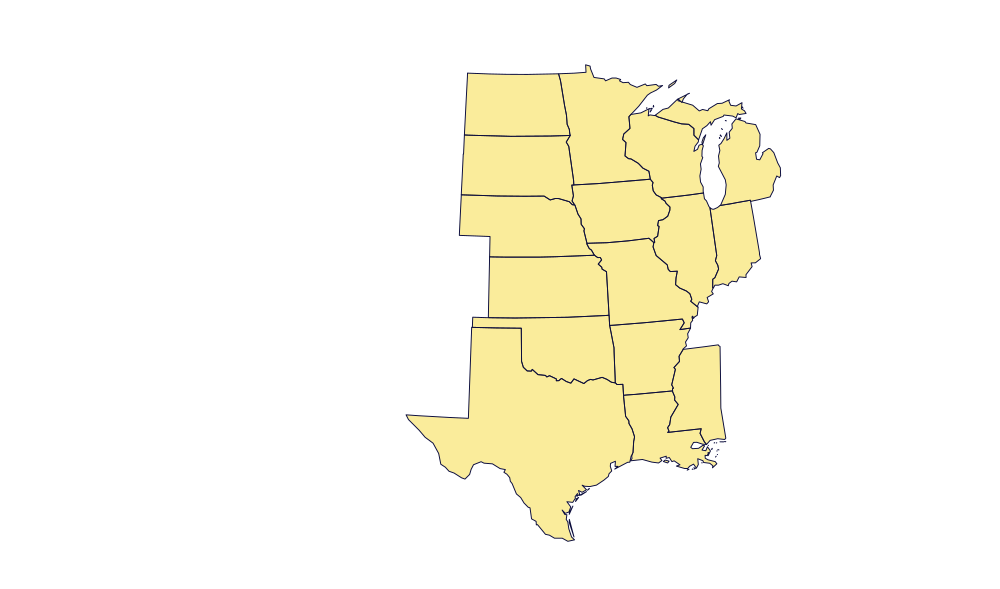
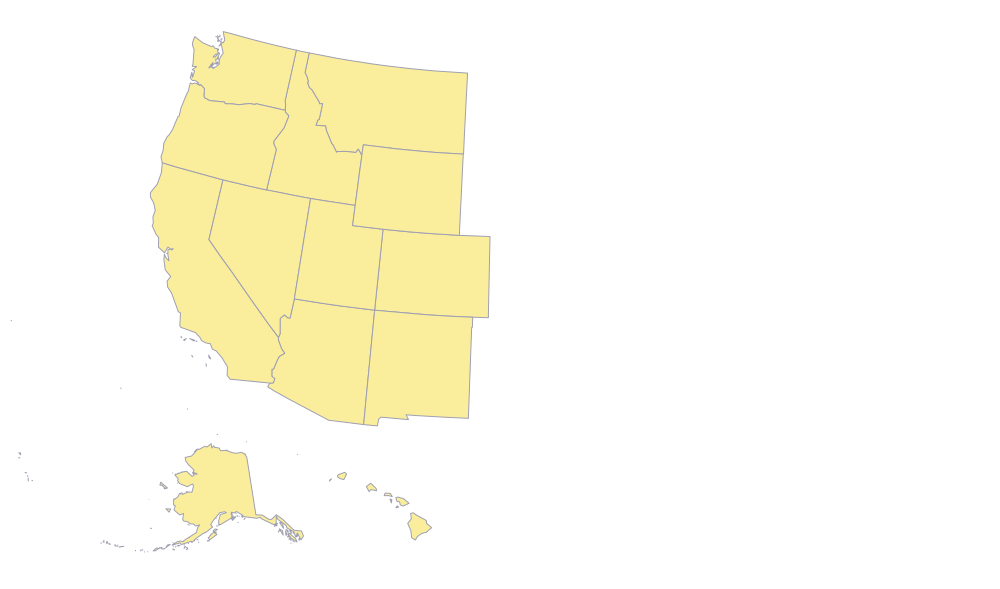
AVLS operate and has proven pool of AV technicians in major cities US Nationwide, such as Las Vegas, Los Angeles, Orlando, Dallas, San Antonio, Austin, Houston, Washington DC, Atlanta, New Orleans, Tennessee and more.
Please complete the form below and we will respond to you as soon as possible. We are available 24 hours a day to assist with your needs. We look forward to showing you what we can do toward the success of your next event.
EVENT INFORMATION
