





Event Management Technology in 2026: The Stack Map, Integration Matrix and Failure-Planning Framework
Event management technology is the connected set of software, onsite systems, AV infrastructure, networks, and data tools used to plan, deliver, and measure an event. A reliable stack may include registration, CRM, check-in, badging, apps, engagement tools, AV, streaming, connectivity, and analytics. The goal is not to use every tool. It is to define what each system does, how systems exchange data, who operates them, and what happens when a critical dependency fails.
Key Takeaways
- Event management technology is a stack, not a single platform. Registration, CRM, check-in, mobile apps, AV, streaming, connectivity, and analytics may all depend on one another.
- Every critical data object needs an intended system of record. Decide which system owns attendee identity, payment status, agenda data, attendance, and engagement records.
- Bizzabo reports that 79% of surveyed organizers integrate their event platform with CRM or marketing automation. That makes integration design a core buying issue, not an optional technical detail.
- There is no universal bandwidth figure for an event. Zoom meetings, Teams large-event viewing, and YouTube livestream ingest are different network workloads.
- Accessibility, cybersecurity, and privacy should be reviewed before a platform is bought. Law, technical guidance, and voluntary frameworks must also be kept separate.
- Every mission-critical system needs an owner, a fallback, and a test. A recovery plan matters as much as the feature list.
What Event Management Technology Actually Includes
Event management technology covers the digital and physical systems used to plan, market, register, admit, communicate with, engage, produce, stream, and measure an event.
A registration platform may collect attendee data. A CRM may manage follow-up. A mobile app may publish the agenda. Badge printers and scanners may control entry. AV systems deliver the content people came to see. Network infrastructure keeps many of those systems connected.
The Event Management Technology Stack
The stack below is a planning model, not an industry standard. Not every event needs every layer.
Technology Layer | Before the Event | Onsite / Arrival | During Sessions | After the Event |
Planning and project tools | Scope, tasks, schedules | Issue tracking | Live coordination | Review and lessons learned |
Registration and payments | Sign-up, ticketing, payment | Lookup and exceptions | Limited role | Reconciliation |
Attendee database | Identity and profile records | Identity checks and updates | Personalization | Segmentation |
CRM and marketing | Invitations and campaigns | Triggered messages | Engagement triggers | Follow-up |
Speaker and content tools | Abstracts, files, approvals | Final changes | Presentation delivery | Archive |
Check-in, badging, access | Credential setup | Admission and badge print | Session access | Attendance records |
Mobile app and navigation | Agenda and planning | Maps and alerts | Agenda, networking, alerts | Content and follow-up |
Engagement tools | Matching and setup | Networking | Polls, Q&A, community | Engagement analysis |
Sponsor and exhibitor tools | Lead workflow setup | Scanning | Lead capture | Export and follow-up |
AV and show control | Production planning | Setup and testing | Audio, video, lighting | Archive |
Livestream and hybrid systems | Platform setup and rehearsal | Connectivity checks | Distribution and remote participation | Recording and VOD |
Connectivity | Capacity planning | Coverage checks | Operational network | Logs and review |
Analytics | KPI design | Attendance capture | Live telemetry | Reporting and attribution |
Accessibility | Site, app, and content checks | Accessible interfaces | Captions and access services | Accessible archives |
Security and privacy | Data mapping and access rules | Access control | Monitoring | Retention and deletion |
A small internal meeting may use only a few of these layers. A multi-day conference may use almost all of them.
The stack should match the event, not the other way around.
Registration is already measurable technology
Bizzabo’s 2026 event marketing statistics report a 24.4% visit-to-registration conversion rate for dynamic registration flows versus 11.6% for static flows in its platform data.
That is an observational benchmark, not a controlled experiment. It does not prove dynamic forms alone caused the difference.
Decision Factor | All-in-One Often Fits Better | Specialized Stack Often Fits Better |
Team size | Smaller team that needs fewer admin tools | Team with specialist owners |
Integration burden | Fewer external systems are preferred | Strong API and integration skills exist |
Workflow depth | Processes are fairly standard | One or more workflows are highly specialized |
Data model | Central platform ownership is useful | Different systems need clear ownership |
AV and production | Basic embedded tools may be enough | Complex production or broadcast needs exist |
Procurement | Fewer vendor relationships are preferred | Best tool per function matters more |
Failure isolation | Shared platform risk is acceptable | Teams want to separate some failure domains |
Implementation | Faster setup matters most | Architecture effort is acceptable |
Define Which System Owns the Data
Integration gets easier to reason about once every important data object has an intended owner.
Bizzabo reports that 79% of surveyed organizers have their event platform integrated with CRM or marketing automation.
That figure comes from Bizzabo’s own research population. It should not be read as a census of all U.S. events. The same Bizzabo research is also the source for the attendee-app and event-format benchmarks referenced later in this article.
Source-of-Truth and Integration Matrix
Data Object | Intended Authoritative System | Typical Downstream Systems | Failure Consequence |
Attendee identity | Registration platform or CDP | CRM, app, badge system | Duplicate or incorrect attendee records |
Payment status | Registration or payment processor | Finance, check-in | Admission or reconciliation errors |
Agenda | Event CMS | Website, app, signage | Conflicting schedules |
Speaker and session data | Content system | Website, app, presentation workflow | Wrong session information |
Badge and access status | Registration or access platform | Printers, scanners | Entry delays or access errors |
Session attendance | Scanner or event app | Analytics, CRM | Weak follow-up data |
Engagement data | App or engagement platform | Analytics, CRM | Attribution gaps |
Sponsor leads | Lead-capture platform | CRM | Delayed or incomplete follow-up |
Registration, Check-In, Badging, and Identity Form One Chain
One duplicate attendee profile may create two badges. An unsynced payment may cause an entry problem. An agenda update may reach the website but not the app.
Before doors open, test common exceptions too:
- A person registers onsite.
- A name must be corrected.
- A badge is reprinted.
Network Capacity: There Is No Single “Mbps for Events” Number
Different event technologies use networks in very different ways.
The manufacturer figures below show the difference.
Workflow | Published Reference | What It Represents |
Zoom group 1080p | About 3.8 Mbps up / 3.0 Mbps down | Interactive endpoint |
Microsoft Teams large-event viewer without eCDN | About 2 Mbps per viewer; Microsoft cites 3 Mbps for 1080p | Enterprise audience distribution |
YouTube H.264 1080p30 ingest | 10 Mbps recommended bitrate | Livestream contribution |
YouTube H.264 1080p60 ingest | 12 Mbps recommended bitrate | Higher-frame-rate livestream contribution |
Sources: Zoom system requirements, Microsoft Teams network guidance, and YouTube encoder settings.
Zoom lists about 3.8 Mbps upstream and 3.0 Mbps downstream for group 1080p, while YouTube recommends a 10 Mbps H.264 bitrate for 1080p30 ingest. These figures describe different jobs and should not be averaged.
Venue planning must also account for concurrent users, Wi-Fi coverage, wired production traffic, guest traffic, upstream capacity, and redundancy.
U.S. Accessibility and Governance Map
Source | What It Is | Safe Use |
U.S. DOJ Title II web and mobile-app rule | Legal rule for covered state and local government entities | Use WCAG 2.1 Level AA and applicable deadlines |
DOJ Title III web guidance | ADA guidance for businesses open to the public | Explain accessibility duties without inventing one universal technical standard |
W3C WCAG 2.2 | Current W3C recommendation | Modern accessibility design reference |
NIST Cybersecurity Framework 2.0 | Cyber-risk management framework | Vendor/security-question framework |
NIST Privacy Framework | Privacy-risk framework | Data-governance framework |
The U.S. Department of Justice Title II rule identifies WCAG 2.1 Level AA as the technical standard for covered state and local government entities.
The W3C WCAG publication contains the newer WCAG 2.2 recommendation.
The DOJ’s web accessibility guidance for businesses should be reviewed separately for private-sector accessibility obligations.
The DOJ’s current Title II compliance guide lists April 26, 2027 and April 26, 2028 compliance dates for different covered public entities under the updated timeline.
For cybersecurity, NIST Cybersecurity Framework 2.0 offers a risk-management structure. The NIST Privacy Framework supports privacy-risk planning.
Plan for Failure Before the Event Starts
Every critical system should have three things:
an owner, a fallback, and a test.
The point is not to predict failure rates. It is to stop one known dependency from becoming an avoidable show-stopper.
Failure and Fallback Matrix
Failure | Likely Effect | Minimum Fallback | Owner | Pre-Event Test |
Registration platform unavailable | Records cannot be retrieved or updated | Exported attendee list or manual process | Registration lead | Simulate unavailable platform |
Check-in internet outage | Lookup or scanners may stop | Offline or local workflow if supported | Registration and network lead | Disconnect network |
Badge printer failure | Entry slows | Spare printer or manual credential process | Registration lead | Swap printer |
Event app outage | Agenda or navigation may disappear | Web, printed, or onsite backup | Event operations | Remove app access |
API sync failure | Systems diverge | Queue or manual reconciliation | Integration owner | Pause sync |
Wrong agenda version | Conflicting session details | One authoritative publishing path | Content owner | Check version flow |
Presentation computer failure | Session may stop | Backup playback or presentation system | AV team | Fail over device |
Encoder failure | Stream stops | Backup encoder or approved alternate path | Streaming lead | Controlled failover |
Primary internet failure | Distribution may fail | Secondary connection where required | Network or production lead | Connection failover |
Remote presenter disconnects | Speaker disappears | Reconnect process or local content backup | Producer | Presenter drop test |
Analytics sync fails | Reports become incomplete | Preserve raw source data | Data owner | Delay sync |
For complex events, technical ownership becomes a staffing issue as much as a software issue.
AI in Event Management Technology
AI is relevant in 2026, but it should be attached to a real workflow.
Useful applications may include drafting communications, segmenting attendees, recommending content, supporting planning, summarizing data, and helping service teams handle routine requests.
Metric Does Not Equal Outcome
Metric | Does Not Automatically Prove | Better Supporting Evidence |
Registrations | Attendance | Check-in data |
App downloads | Active use | Sessions, actions, retention |
Messages | Networking quality | Meetings, surveys, outcomes |
Session scans | Learning | Assessment or feedback |
Leads | Pipeline | CRM progression |
Stream views | Attention | Watch time and retention |
Poll responses | Satisfaction | Satisfaction feedback |
Badge scans | Qualified opportunities | Qualification and pipeline data |
Build the Procurement Scorecard Before Watching Demos
Mark each factor as required, preferred, or unnecessary.
Then evaluate:
- Business outcome
- Lifecycle coverage
- Attendee experience
- Registration
As of October 5, 2026, Eventbrite’s U.S. organizer pricing lists a 3.7% + $1.79 service fee per paid ticket, plus a 2.9% payment-processing fee per order.
It shows why buyers should look beyond a headline platform fee. Transaction costs, hardware, support, integration work, and onsite labor may all change the real cost.
4 Questions to Ask an Event Technology Vendor
- Which system becomes the authoritative attendee record?
- Which integrations are native, API-based, or custom?
- What happens if an integration is delayed or unavailable?
- Can check-in continue when internet access is lost?
A Simple Event Technology Selection Sequence
Use this order before choosing products.
1. Define the outcome
State what the event should achieve.
2. Map the attendee and operator journey
List what must happen before, onsite, during, and after the event.
3. Define required capabilities
Do this before naming vendors.
4. Assign systems of record
Decide who owns attendee identity, payment, agenda, attendance, and engagement data.
5. Map integrations
Document what each system sends and receives.
6. Map infrastructure dependencies
Include internet, Wi-Fi, printers, scanners, mobile devices, AV, and streaming.
Frequently Asked Questions
Is an all-in-one event platform better than specialized tools?
It depends on the event. All-in-one platforms can reduce administrative and integration work. Specialist tools may be better where deeper functionality is required. The decision should be based on workflow depth, data ownership, integration needs, team skills, and production complexity.
Which event systems should connect to CRM?
Registration, attendee identity, attendance, engagement, sponsor leads, and follow-up data are common candidates. The exact design depends on what the CRM is expected to own. Each data flow should have a clear source of truth and a conflict-resolution rule.
How much internet bandwidth does a livestream or hybrid event need?
There is no single correct figure. Zoom, Microsoft Teams, and YouTube publish different network figures because they describe different workloads. Venue capacity must be calculated from the actual platforms, concurrent users, production traffic, upload needs, and redundancy plan.
Build the Event Around the Workflow, Not the Software
The strongest event technology plan starts with the event itself.
Define the outcome. Map the attendee journey. Decide which systems own the data. Find the integrations. Identify the physical infrastructure. Assign operators. Test failure paths. Then compare platforms.
For events that need professional AV, video, streaming, or onsite technical crews, AV Labor Source can help support the production layer of that technology stack.
CONTACT US
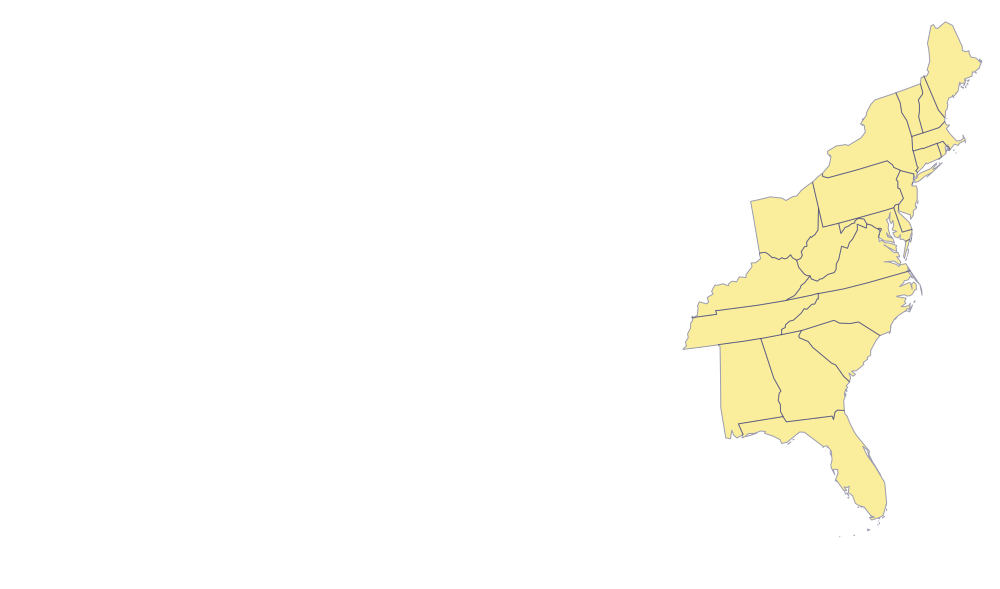
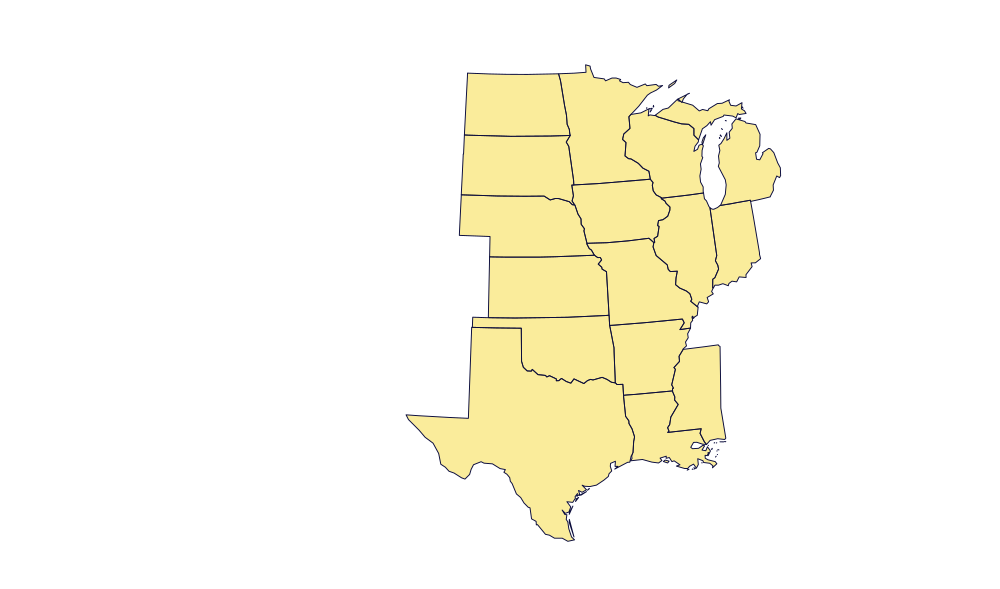
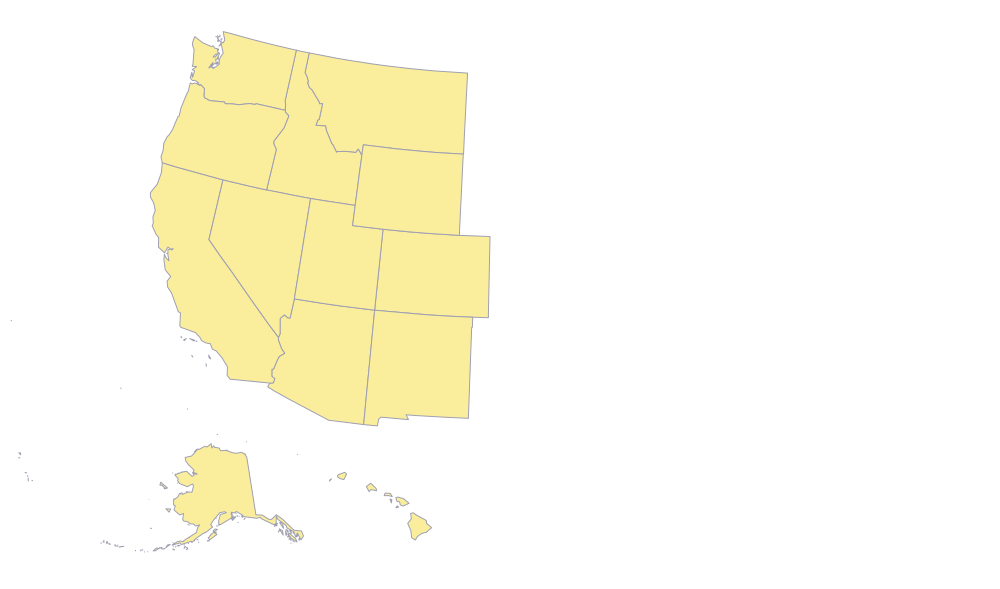
AVLS operate and has proven pool of AV technicians in major cities US Nationwide, such as Las Vegas, Los Angeles, Orlando, Dallas, San Antonio, Austin, Houston, Washington DC, Atlanta, New Orleans, Tennessee and more.
Please complete the form below and we will respond to you as soon as possible. We are available 24 hours a day to assist with your needs. We look forward to showing you what we can do toward the success of your next event.
EVENT INFORMATION
