





Event Production in the U.S.: Crew Roles, Safety Standards & a Quote-Normalization Framework
Event production is the technical process of turning an event plan into a working live show. It can include audio, video, lighting, staging, cameras, playback, streaming, technical crews and show management. Exact scope varies by provider and venue. Buyers should define responsibilities early, verify safety and technical constraints, allow time for testing and rehearsal, and compare production proposals line by line rather than by headline price alone.
Key Takeaways
- “Event production” does not have one universal scope. Define exactly what the organizer, venue, production partner and specialist contractors will handle.
- Specialist audio, video, lighting, playback, camera and management roles become more important as technical complexity increases; there is no universal attendee-to-technician staffing ratio.
- Rigging, power, RF coordination, accessibility and safety can involve parties outside the core AV team.
- Production starts well before show day with briefing, venue review, system design, staffing, documentation, testing and rehearsal.
- Current published production prices vary sharply because event scopes differ, so vendor figures should not be treated as a single U.S. average.
- The best way to compare competing proposals is to normalize equipment, labor, rehearsal, venue fees, specialist services, exclusions and overtime assumptions.
What Is Event Production?
Event production is often used as a broad term, and that creates confusion before a project even begins.
Some companies use it to describe much of the overall event-delivery process, including logistics, venue coordination and attendee experience. Technical production providers often use the term more narrowly for the systems and people that make the live show work: audio, video, lighting, staging, LED, projection, cameras, playback, streaming, rigging coordination, power coordination and technical crew.
For buyers, the exact label matters less than the contracted scope.
A provider describing itself as an “event production company” may offer everything from creative direction through strike. Another may focus primarily on technical systems. A venue may require some services to remain in-house. A specialist contractor may be needed for rigging, electrical work or engineering.
That is why one of the first production questions should be:
What does “event production” mean in this proposal, and which responsibilities remain outside it?
Basic AV rental is usually narrower. Renting microphones, speakers, screens or projectors does not automatically include system engineering, specialist operators, content management, rehearsals, show calling, venue coordination or technical decision-making during the program.
Modern live production is better understood as a system of equipment, people, responsibilities and timing.
Who Owns What? An Event Production Responsibility Matrix
Production problems often begin when everybody assumes somebody else owns a task.
The following matrix is a planning framework, not a legal allocation of responsibility. Actual ownership depends on the venue, contract, local requirements, project structure and specialist scope.
Production Task | Event Organizer | Venue | Production Partner | Specialist / Authority |
Event objectives and program | Primary | — | Consulted | — |
AV system design | Provides requirements | Provides constraints | Usually leads technical design | Engineering support where required |
Technical labor | Defines needs | May impose conditions | Provides or coordinates crew | Specialist trades where needed |
Rigging | Defines production needs | Often controls points/rules | Coordinates technical requirements | Qualified rigging/engineering personnel |
Electrical/power | Supplies load requirements | Defines venue rules | Coordinates production demand | Qualified electrical provider |
RF coordination | Supplies microphone/comms needs | Provides site/environment input | Audio team coordinates systems | FCC rules constrain operation |
Accessibility AV | Defines audience/program needs | Facility obligations may apply | Coordinates implementation | Accessibility/legal expertise where appropriate |
Severe weather planning | Overall event responsibility | Site coordination | Production input | Weather/public-safety expertise |
The key is not to assume that one vendor automatically owns every technical and safety responsibility.
Rigging illustrates the problem well. The production designer may know what must be suspended, but the venue may control rigging points. A qualified rigging provider may perform the work, and engineering may be required in some circumstances. Similar boundaries exist around power, temporary structures, internet, accessibility and venue-exclusive services.
Responsibilities should therefore be assigned before load-in, not discovered while trucks are already at the dock.
Who Is on an Event Production Crew?
Crew structure should follow the systems being operated, the number of rooms, show complexity, rehearsal needs and schedule—not a simple attendee-count formula.
AV Labor Source publishes a detailed role taxonomy across audio, video, lighting, playback, cameras and show management. Buyers who need nationwide technical staffing can review its AV technical staffing services when translating a production plan into specific labor roles.
Audio: A1 and A2
In AV Labor Source’s terminology, the A1 is the lead audio role. That person typically has responsibility for the main audio system and mix.
An A2 supports the audio department and may handle areas such as stage inputs, microphones, communications, cabling and other operational tasks depending on the production.
The point is not that every show must have exactly one A1 and one A2. A simple meeting and a multi-room program with many wireless microphones require very different labor plans.
Video: V1, V2, Projection and LED
The V1 is the lead video role in AV Labor Source’s role structure. The V1 may oversee the primary video system and its operation.
V2 personnel support video-system setup and operation. Other specialists can include projectionists and LED-wall technicians or programmers.
Video complexity rises quickly when an event adds:
- multiple displays;
- large LED surfaces;
- confidence monitors;
- cameras and image magnification;
- multiple presentation sources;
- playback;
- remote contributors;
- streaming;
- redundant signal paths.
At that point, treating “video” as one generic technician assignment can hide important differences in responsibility.
Lighting
Lighting roles can include a lighting designer, L1, L2 and other specialist functions.
A lighting designer focuses on the visual design and programming intent. Lead and supporting lighting technicians then translate that design into installed and operational systems.
Lighting may also intersect with electrical planning, rigging, venue restrictions and safety requirements.
Playback, Graphics and Content
Corporate shows often depend as much on content execution as on physical AV equipment.
Playback and GFX/CPU technicians may manage presentation files, videos, graphics and computer-based content. A single high-stakes presentation with last-minute revisions can require more operational discipline than a much larger but simpler room.
Camera Operators
Camera operators become relevant when the event includes recording, IMAG, broadcast-style production, streaming or hybrid delivery.
The camera department may also depend on video switching, communications, shading or other functions depending on production complexity.
Show and Labor Management
Technical directors, project managers, labor coordinators and crew leads address a different problem: coordinating people, systems and timing.
AV Labor Source’s own service model publishes thresholds for certain management roles, but those thresholds should be understood as its operating model—not universal industry requirements.
For more detail on evaluating personnel, see its guidance on hiring a skilled technical event crew and its overview of professional AV specialists for live events.
Federal labor data also shows that audio/video, sound engineering and lighting are treated as distinct occupations rather than one undifferentiated technical role.
In May 2025, the U.S. Bureau of Labor Statistics reported 70,230 audio and video technicians nationwide.
BLS also reported 13,080 sound-engineering technicians and 8,900 lighting technicians.
Those figures cover multiple employment settings, so they should not be interpreted as the size of the live-event workforce alone. They do, however, reinforce the fact that these are distinct technical disciplines.
The Event Production Process: From Brief to Strike
A production does not begin when equipment reaches the venue.
A useful lifecycle is:
Brief → Venue/Site Review → System Design → Staffing and Sourcing → Technical Documentation → Content Collection → Load-In → System Test → Rehearsal → Doors/Show → Strike → Post-Event Deliverables
- Brief
Useful inputs include:
event format;
number of rooms;
program schedule;
presentation types;
audience size and seating;
speaker count;
microphone needs;
content formats;
cameras or IMAG;
streaming or remote presenters;
scenic and staging expectations;
accessibility requirements;
venue constraints;
expected rehearsal time.
A weak brief forces vendors to fill gaps with assumptions, which makes proposal comparison harder later.
2. Venue and Site Review
The venue can change the production plan substantially.
Questions may include:
Where can equipment be loaded?
How much setup time is available?
What rigging rules apply?
What power is available?
Is venue internet adequate for streaming?
Are any services exclusive to the venue?
Where can front-of-house control be positioned?
Are there restrictions on sound, lighting, cable routes or temporary structures?
3.System Design and Staffing
Once the event requirements and venue constraints are known, the technical plan can be developed.
This is where equipment and people should be considered together.
A large LED wall without qualified video support is not a complete solution. Neither is a complex wireless microphone plan without RF coordination or a camera package without an operating workflow.
4. Load-In and Testing
Installed is not the same as show-ready.
Audio systems need checking. Video signal paths must be confirmed. Presentations need testing. Lighting cues need programming. Cameras, communications, playback and redundant systems must work together.
Testing gives the production team time to identify and address issues before the audience is in the room.
5.Rehearsal
Rehearsal should be treated as a production requirement that consumes both venue time and crew hours.
It is especially valuable for:
executive presentations;
complex walk-ons;
timed video;
remote contributors;
camera blocking;
panel transitions;
award sequences;
show calling;
lighting cues;
graphics and playback.
Rehearsal is also a useful line item to check in competing proposals. One quote may include it while another may not.
6. Show and Strike
During the live program, operators execute the prepared system and respond to real-time changes.
Afterward, strike requires its own labor, timing and venue coordination. A quote that includes show operation but does not clearly account for strike labor can look cheaper without actually representing the same scope.
The U.S. Technical Risks Buyers Should Resolve Before Show Day
Some event-production risks are governed or informed by authoritative standards and regulations. Others depend on venue rules, contracts and local requirements.
The important distinction is that citing an ANSI standard does not mean that every provision is automatically law at every U.S. event. Applicability can depend on adoption, contract and jurisdiction.
Risk Area | Source / Standard | Production Implication |
Electrical and event lighting | ANSI ES1.17-2025 | Addresses safe practices during installation, use and dismantling |
Event rigging | ANSI ES1.18-2022 | Provides requirements/guidance for suspension of production equipment and materials |
Weather | ANSI ES1.7-2021 + National Weather Service | Outdoor shows need a documented weather-response process |
Crowd management | ANSI ES1.9-2020 | Technical production interfaces with wider event operations |
Wireless microphones | FCC rules | Frequency use must be coordinated within current rules |
Assistive listening | ADA / U.S. Access Board | Accessibility may directly affect AV planning |
Electrical and Rigging
ESTA lists ANSI ES1.17-2025, Event Safety — Event Lighting & Electrical Safety, which addresses safe electrical working practices for event systems and equipment during installation, use and dismantling.
ESTA also lists ANSI ES1.18-2022, Event Safety — Rigging, covering technical event-production rigging.
These standards are useful planning references. They should not be rewritten into unsupported claims that one specific company is automatically legally responsible for every electrical or rigging condition.
Wireless Microphones and RF
Wireless audio deserves more attention than it often receives in early production discussions.
Current FCC rules regulate where wireless microphones can operate and under what conditions. Relevant rule text includes operation in specified broadcast-TV spectrum and portions of the 600 MHz guard band and duplex gap.
Current rule material includes the 614–616 MHz guard-band segment and 657–663 MHz duplex-gap segment under applicable conditions.
Older wireless equipment deserves particular scrutiny.
FCC material states that wireless microphones were required to stop operating in the 617–652 MHz and 663–698 MHz service bands following the 600 MHz transition.
The practical buyer lesson is simple: do not assume a wireless system is legal or suitable for a venue merely because it worked at an older event. Spectrum should be checked and coordinated for the current location and equipment.
Accessibility and Assistive Listening
Accessibility can directly affect AV scope.
The U.S. Access Board publishes guidance comparing ADA and building-code requirements for assistive-listening systems in assembly areas. Its tables include receiver counts based on seating capacity under the applicable framework.
Those numbers should not be simplified into a universal rule such as “every event over X people legally needs Y receivers.” Applicability depends on factors such as the facility, fixed seating, amplification and the relevant accessibility provisions.
The planning takeaway is more useful: discuss accessibility with the venue and organizer early enough for assistive listening or related services to be incorporated into the technical scope.
Outdoor Event Production Needs a Stop/Go Plan
Outdoor events add weather exposure to every other technical dependency.
A useful preparedness discussion should answer:
- Who monitors authoritative weather information?
- Where is safe shelter?
- How long does it take to move attendees and crew?
- Who has the authority to pause the event?
- How are instructions communicated?
- Which structures and technical systems are exposed?
- What conditions control restart?
- How are decisions documented?
The National Weather Service provides two especially useful pieces of lightning guidance.
The National Weather Service notes that lightning can strike as far as 10 miles from rainfall.
Its guidance also says people should remain in safe shelter for at least 30 minutes after the last sound of thunder.
Those facts do not establish a universal “cancel the event at exactly 10 miles” rule. Weather plans must consider the site, shelter, evacuation time, temporary structures, local conditions and the people responsible for making decisions.
What Does Event Production Cost in 2026?
There is no defensible single national price for event production in the available evidence.
Current vendors publish dramatically different ranges because they are describing different events, inclusions and service models.
AVFX published the following 2026 examples:
- single-room general session: $25,000–$75,000;
- branded staging with moderate LED: $75,000–$175,000;
- multi-day, multi-room conference: $175,000–$350,000;
- high-profile or large-scale programs: $350,000+.
Centric publishes lower examples for some scopes:
- basic half-day meeting: $3,000–$8,000;
- full-day conference with custom staging, LED and professional lighting: $15,000–$50,000;
- multi-day event with breakouts, IMAG and live streaming: $50,000–$150,000+.
Stagedge says production-support engagements start around $10,000, full-event programs typically start around $35,000, and conferences, leadership meetings and multi-room programs can range from $90,000 to $750,000.
These are vendor-published orientation figures, not audited national averages.
The apparent contradiction is useful because it shows why “What does event production cost?” is often the wrong first question.
A better question is:
What scope is driving the price?
The Main Cost Drivers
A practical framework is:
Scale × Duration × Rooms × LED/Scenic Complexity × Cameras/Streaming × Rehearsal × Crew Specialization × Venue Constraints × Rigging/Power × Travel × Redundancy
Two events with the same attendance can have very different technical requirements.
A 700-person keynote with one stage can be operationally simpler than a smaller event with six simultaneous breakouts, many presenters, extensive wireless audio, cameras, streaming and tight room-change schedules.
How to Compare Event Production Quotes Fairly
This is where buyers can avoid one of the most common procurement mistakes: comparing headline totals before comparing scope.
Quote-Normalization Matrix
Scope Item | Vendor A | Vendor B | Included? | Quantity / Hours | Exclusions | Buyer Question |
Audio system | — | — | — | — | — | Same room coverage and microphone scope? |
Video/screens/LED | — | — | — | — | — | Same display technology and size? |
Lighting | — | — | — | — | — | Design, fixtures and programming included? |
Scenic/staging | — | — | — | — | — | Same stage and scenic assumptions? |
Cameras/IMAG | — | — | — | — | — | Camera count and operators included? |
Streaming | — | — | — | — | — | Platform, encoding and labor included? |
Playback/GFX | — | — | — | — | — | Dedicated operator included? |
Project/show management | — | — | — | — | — | On-site and pre-production hours included? |
Rehearsal | — | — | — | — | — | How many crew hours? |
Load-in/strike | — | — | — | — | — | Same schedule assumptions? |
Travel/per diem | — | — | — | — | — | Included or additional? |
Rigging | — | — | — | — | — | Venue or external specialist? |
Electrical | — | — | — | — | — | Venue service or vendor scope? |
Internet/bandwidth | — | — | — | — | — | Dedicated service included? |
Accessibility services | — | — | — | — | — | Assistive audio/captioning scoped? |
Redundancy/backups | — | — | — | — | — | What failures are covered? |
Venue fees | — | — | — | — | — | Included or pass-through? |
Overtime assumptions | — | — | — | — | — | What triggers additional charges? |
Decision rule: normalize scope before comparing headline price.
A lower quote may simply exclude rehearsal, travel, venue labor, electrical, rigging, streaming, accessibility services or overtime assumptions that another provider has already included.
That does not make either quote wrong. It means the buyer must make them comparable.
Questions to Ask Before Signing an Event Production Contract
A useful production conversation should answer more than “What equipment are you bringing?”
Ask:
- What is included in the production scope?
- What is specifically excluded?
- Which technical disciplines have dedicated lead operators?
- Who coordinates with the venue?
- Who owns rigging planning and approvals where required?
- Who coordinates electrical and power requirements?
- How will wireless spectrum be verified?
- How much rehearsal is included?
- What assumptions were made about load-in and strike?
- Which venue-exclusive services remain outside the contract?
- What redundancy exists for mission-critical presentation systems?
- How are schedule changes and overtime handled?
- For outdoor events, who monitors weather and who has stop/restart authority?
- What accessibility requirements must be added to the technical plan?
These questions also help the production partner create a more meaningful estimate because fewer unknowns are left to assumption.
When Does an Event Need More Specialized Crew?
There is no authoritative universal formula that says a certain audience size requires a fixed number of technicians.
Technical specialization is more closely tied to complexity.
Specialist roles may become more useful as an event adds:
- multiple rooms;
- simultaneous sessions;
- complex audio;
- many wireless channels;
- large LED systems;
- cameras and IMAG;
- streaming;
- graphics and playback;
- complex lighting;
- short changeovers;
- high rehearsal demands;
- executive or broadcast-style production;
- compressed load-in schedules.
This is why crew should be designed around the production system rather than around attendance alone.
For examples of location-specific technical labor capabilities, AV Labor Source also publishes information for AV technicians in Las Vegas and AV technicians in Austin.
Frequently Asked Questions
What is event production?
Event production is the technical planning and execution required to turn an event program into a functioning live show. Depending on scope, it can include audio, video, lighting, staging, cameras, playback, streaming, technical labor, rehearsal, show management and strike.
What is the difference between event planning and event production?
Event planning usually covers the broader event, such as venue, schedule, guests and logistics. Technical event production focuses more closely on the systems, people and workflows required to deliver the live program. The boundary varies by company, so buyers should define the contracted scope explicitly.
What services are normally included in event production?
Common services include audio, video, lighting, staging, LED or projection, cameras, playback, streaming and technical management. However, rigging, electrical service, internet, venue labor, accessibility services and other specialist requirements may be separate.
How much does event production cost?
There is no reliable single U.S. average because production scopes vary substantially. Published 2026 vendor examples range from a few thousand dollars for simpler meetings to hundreds of thousands of dollars for large, multi-room or high-production programs. Scope matters more than attendee count alone.
What does an event production crew include?
Depending on the event, a crew may include audio leads and assistants, video leads and technicians, lighting personnel, playback/GFX operators, LED or projection specialists, camera operators, technical directors, project managers and labor-management roles.
Who handles rigging and electrical power?
It depends on the venue, contract and project. The production partner may coordinate requirements, while the venue or specialist rigging, engineering or electrical providers perform or approve the work.
How early should event production planning begin?
There is no universal lead time supported by the evidence. Planning should begin early enough to review the venue, design the technical system, source equipment and personnel, coordinate content, resolve specialist requirements, test systems and conduct necessary rehearsals.
What should I compare between event production quotes?
Compare equivalent scope rather than totals alone. Review equipment, labor hours, rehearsal, load-in and strike, project management, rigging, power, internet, streaming, travel, venue fees, accessibility services, backups, overtime rules and exclusions.
Build the Production Scope Before You Build the Crew
Event production becomes easier to buy when responsibilities, systems and labor are treated as one connected plan.
Define the production scope. Confirm venue boundaries. Identify specialist disciplines. Resolve rigging, electrical, RF, accessibility and weather considerations early. Build testing and rehearsal into the schedule. Then normalize competing quotes before deciding which proposal actually represents the best fit for the event.
For organizations that already know their technical scope and need experienced personnel to execute it, AV Labor Source provides nationwide technical event staffing across audio, video, lighting, cameras, playback and show-management roles.


CONTACT US
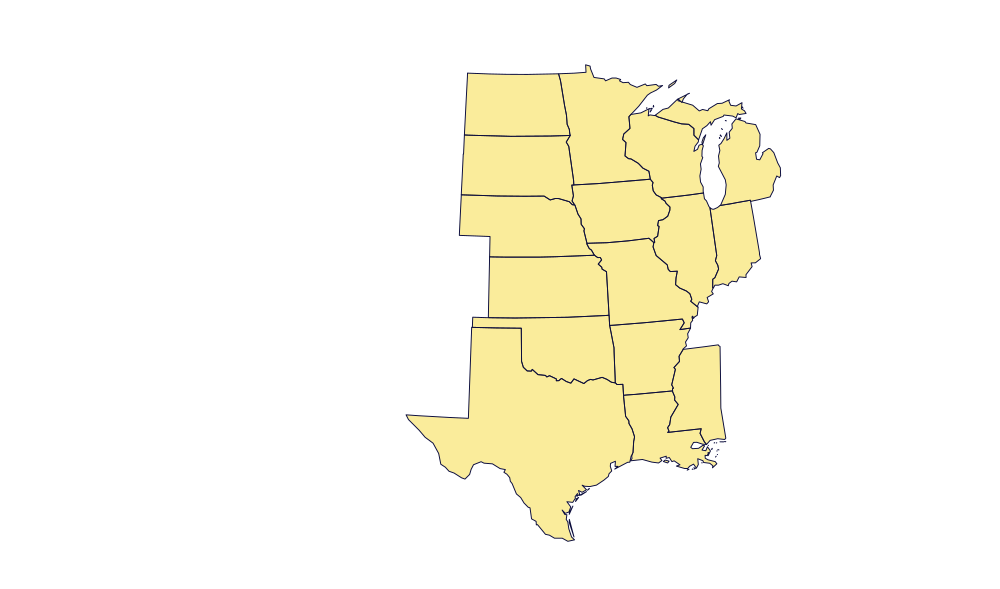
AVLS operate and has proven pool of AV technicians in major cities US Nationwide, such as Las Vegas, Los Angeles, Orlando, Dallas, San Antonio, Austin, Houston, Washington DC, Atlanta, New Orleans, Tennessee and more.
Please complete the form below and we will respond to you as soon as possible. We are available 24 hours a day to assist with your needs. We look forward to showing you what we can do toward the success of your next event.
EVENT INFORMATION
