


Published on November 10, 2026
Promotional Event Staffing: Roles, Planning, and Campaign Costs
Quick Answer
Promotional event staffing means providing trained representatives to engage visitors, introduce products, distribute samples, demonstrate features, and generate meaningful marketing leads at live events. Successful campaigns begin by identifying the interactions that need to happen, assigning the right people to those positions, and coordinating their work with the event's technical production team. The goal is not simply to put more people on a floor. It is to create useful, measurable interactions with the right audience.
Key Takeaways
- Match promotional roles to campaign objectives such as awareness, product education, sampling, or lead generation.
- Brand ambassadors, promotional models, demonstrators, and sampling representatives have different primary responsibilities.
- Calculate staffing from simultaneous positions, peak visitor demand, breaks, and rotation requirements rather than an unsupported attendee-to-worker ratio.
- Plan staff placement around the visitor journey and the physical layout of the activation.
- Compare complete agency proposals, including training, supervision, travel, overtime, and replacement arrangements.
- Measure meaningful campaign outcomes instead of treating attendance, badge scans, or distributed samples as proof of success.
- Keep promotional responsibilities separate from audiovisual production responsibilities, while coordinating both teams around the same event objectives.
What Promotional Event Staffing Actually Includes
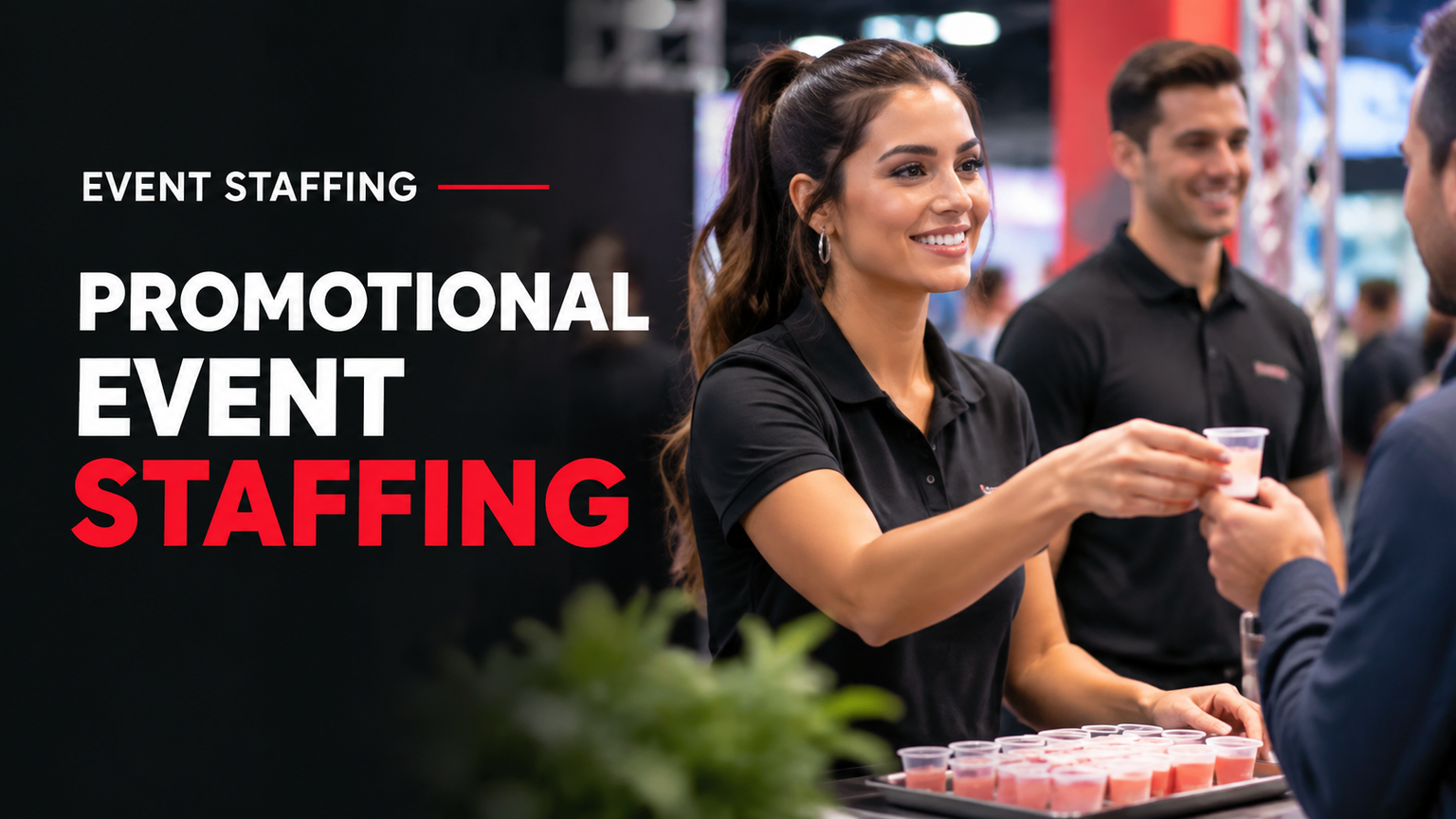
Promotional event staffing puts people in direct contact with a brand's target audience. These representatives help turn a marketing campaign into a live experience by welcoming visitors, explaining products, demonstrating features, distributing samples, and encouraging relevant conversations.
Businesses use promotional personnel at trade shows, product launches, retail demonstrations, festivals, sporting events, conferences, college events, and experiential marketing activations.
The right personnel depend on what the business wants visitors to do. A campaign designed to attract attention needs different capabilities from one that requires detailed product explanations or qualified sales leads.
Common promotional staffing roles include:
| Role | Main responsibility | Typical assignment |
|---|---|---|
| Brand ambassador | Represent the brand and communicate approved messages | Welcome visitors and start conversations |
| Promotional model | Attract attention and increase campaign visibility | Draw visitors toward an activation |
| Product demonstrator | Explain and demonstrate product features | Show visitors how a product works |
| Sampling representative | Distribute products or samples appropriately | Operate a sampling station |
| Booth attendant | Support visitor interactions and booth operations | Welcome exhibitors' visitors and distribute information |
| Lead-generation representative | Identify prospects and capture relevant information | Qualify visitors and record leads |
| Street team member | Promote an activation outside a fixed booth or venue space | Distribute approved materials and direct people to an event |
These titles are not universal job classifications. Agencies sometimes combine several responsibilities into one assignment. For example, a brand ambassador might also demonstrate a simple product and capture visitor information.
When requesting staff, describe the actual duties rather than relying on a job title. This makes it easier to evaluate experience, training needs, and the number of people required.
Published examples of promotional assignments can be found in ATN Event Staffing's brand ambassador role descriptions and its brand ambassador and promotional model assignments.
Choose Staff According to What the Campaign Must Achieve
The campaign objective should determine the staffing plan. Hiring several enthusiastic representatives without defining their responsibilities can produce plenty of activity but little useful evidence of marketing performance.
Start by identifying the main result the campaign is intended to produce.
Building brand awareness
If the priority is visibility, use representatives who can attract attention and encourage appropriate visitors to approach. Promotional models, brand ambassadors, and street teams may support this objective, depending on the event format and venue rules.
Measure relevant visitor approaches, booth visits, QR interactions, and other meaningful engagement indicators. General crowd size alone does not establish that the campaign reached its intended audience.
Starting meaningful conversations
A brand ambassador can welcome visitors, introduce the campaign, answer approved questions, and identify whether someone has a genuine interest in the product or service.
The emphasis should be on relevant conversations rather than the highest possible number of greetings. A short interaction with a suitable prospect may be more valuable than several conversations with people outside the target audience.
Explaining a product
Product demonstrators are useful when visitors need to see a product in operation before understanding its benefits.
The representative should understand the demonstration process, common questions, approved claims, and situations requiring specialist assistance.
For complex or technical products, a qualified technical specialist may need to support the demonstrator. Promotional representatives should not improvise technical explanations beyond their training.
Distributing samples
Sampling representatives manage product distribution and help visitors understand what they are receiving. Their responsibilities may include explaining approved product information, monitoring stock, maintaining an orderly distribution point, and recording quantities.
Sampling campaigns should also account for venue permissions, applicable product-specific requirements, storage conditions where relevant, and safe handling procedures.
Generating qualified leads
A lead-generation representative identifies visitors who meet agreed qualification criteria and records their information through an approved process.
The campaign team should define what makes a lead useful before the event. Depending on the business, qualification may involve purchase interest, business role, budget, location, or a specific requirement.
A badge scan is not automatically a qualified lead. The sales team should agree on the information it needs and how captured contacts will be reviewed and followed up.
The practical relationship between promotional roles and campaign objectives is also explored in Event Staffing's promotional staffing guide and Brand Ambassadors' trade show staffing service overview.
How Many Promotional Staff Members Does an Event Need?
There is no verified universal promotional staffing ratio that applies to every event. The number of people required depends on the activities, physical layout, visitor volume, operating hours, and amount of simultaneous coverage needed.
A more useful method is to count the positions that must be active at the same time.
Required scheduled staff = simultaneous positions + additional coverage for breaks, rotations, and overlapping duties.
This is a practical planning formula, not an empirically validated industry benchmark.
Step 1: List every active position
Start with a simple floor plan or activity schedule. Identify every task that must happen simultaneously.
For example, a product activation might need:
- One person welcoming visitors.
- Two people demonstrating the product at separate stations.
- One person distributing samples.
- One person capturing qualified leads during peak periods, if this cannot be combined with another role.
If all five positions must operate independently, the campaign needs five simultaneously active representatives during that period.
If the duties can be combined without affecting visitor experience or safety, the staffing requirement may be lower. However, avoid assigning two demanding tasks to one person simply to reduce the budget.
Step 2: Consider peak visitor demand
Average attendance can hide the periods when an activation becomes busiest.
A conference booth may experience moderate traffic throughout the morning but receive a large number of visitors immediately after a keynote presentation. A festival sampling station may experience concentrated demand during particular performance breaks.
Identify these peak periods and determine whether additional coverage is necessary.
Step 3: Include breaks and rotations
A position that must remain open cannot simply become unattended when its representative takes a break.
Plan how coverage will work throughout the operating schedule. Depending on the shift length and applicable labor rules, this may require relief personnel, staggered breaks, or scheduled rotations.
Step 4: Decide whether a separate supervisor is necessary
A supervisor may be useful when several representatives work across multiple positions, when the campaign involves complicated procedures, or when immediate decisions are needed during the activation.
Do not automatically count the supervisor as a visitor-facing representative. Their primary responsibility may be attendance, coordination, reporting, and problem resolution.
Worked example: A four-position product activation
Consider an activation with:
| Position | People required simultaneously |
|---|---|
| Visitor greeting | 1 |
| Product demonstrations | 2 |
| Sample distribution | 1 |
| Total active representatives | 4 |
Four people are needed to operate these positions simultaneously. Additional scheduled coverage depends on the operating hours, break policy, shift arrangements, and applicable employment requirements. A separate supervisor may also be appropriate.
This example illustrates how to calculate coverage from actual work. It should not be interpreted as a recommendation that every event needs four representatives or as a standard staffing ratio.
Put Staff Where Visitors Actually Need Them
Good promotional event staffing involves more than selecting capable representatives. Their positions on the event floor can directly affect visitor engagement, queues, accessibility, and the overall experience.
Think about the visitor journey from arrival to departure.
Place greeters at natural entry points
A greeter should be positioned where visitors first decide whether to approach the activation. This might be the entrance to an exhibition booth, a designated product area, or the beginning of an approved event route.
The position should allow the representative to welcome people without obstructing walkways or creating congestion.
Give demonstrations enough space
Demonstrations often attract several visitors at once. The representative needs enough room to operate the product and communicate clearly while allowing people to watch without blocking circulation.
Consider equipment placement, viewing angles, power requirements, audience size, and the space needed for visitors to enter and leave.
Organize sampling stations
A sampling position should have a clear distribution process, accessible stock, and a suitable arrangement for managing waste or packaging.
If visitors must wait, organize the queue so it does not obstruct other exhibitors, emergency routes, or public circulation.
Give lead-capture representatives a clear handoff
Lead capture works best when the representative knows what information to collect, how to record it, and who receives it afterward.
A tablet or badge scanner should be available and tested before the event. Visitors should understand what information is being requested and how it will be used.
Check venue restrictions before finalizing the layout
Exhibitor manuals and venue requirements may control where representatives can distribute materials, conduct sampling, use sound, or approach visitors.
Confirm these arrangements with the organizer before staff are assigned. A promotional activity that works well in an open festival area may not be permitted in a conference aisle or shared exhibition space.
The goal is to make each position useful without creating unnecessary friction for visitors or neighboring exhibitors.
Prepare a Staff Brief That Protects the Brand Experience
Promotional representatives are often the people visitors associate most directly with a campaign. Their preparation should therefore cover the message, the audience, the expected interaction, and the limits of their authority.
A useful briefing document should include the following information.
Campaign objective: Explain what the activation is intended to achieve. Staff should know whether the priority is awareness, demonstrations, sampling, or lead generation.
Target audience: Describe the people the campaign wants to reach and any relevant qualification criteria.
Approved product information: Provide accurate product descriptions, benefits, specifications, and answers to common questions.
Claims that must not be made: Identify statements that are unsupported, misleading, or outside the representative's authority.
Demonstration procedure: Explain how to operate the product, what to show, and what to do if equipment or software fails.
Visitor interaction expectations: Describe the appropriate opening, conversation style, and way to respond when visitors are not interested.
Lead qualification and data handling: Specify what information to collect, how to record it, and the applicable consent and privacy procedures.
Reporting and escalation: Identify the onsite supervisor, marketing contact, technical contact, and emergency procedures.
Teach representatives when to refer questions
A representative should not feel pressured to answer every question independently.
For example, a visitor at a technology launch might ask about system compatibility, network architecture, or a technical specification that has not been included in the promotional briefing.
The correct response is to refer the visitor to a qualified specialist rather than improvise an answer.
The agency and campaign owner should also clarify who prepares training, how much preparation time is required, and whether that time is included in the staffing proposal.
Compare Promotional Staffing Agencies on the Complete Assignment
A promotional staffing agency may coordinate recruitment, selection, scheduling, training, administration, and onsite supervision. However, the services included vary between providers and contracts.
Before selecting an agency, make sure its proposal covers the actual campaign rather than just a number of workers and an hourly figure.
Check experience against the assignment
A representative experienced in retail product sampling may not automatically be suitable for a technical product launch or a corporate exhibition.
Ask whether proposed personnel have experience with the relevant audience, interaction style, event environment, and responsibilities.
Where appropriate, request confirmation of language requirements, product knowledge, presentation skills, and relevant qualifications.
Confirm training and preparation costs
Find out whether the agency prepares representatives before the event and whether the campaign owner must provide additional training.
Clarify whether preparation hours are paid, who supplies the training materials, and whether personnel are expected to attend rehearsals or site orientations.
Check supervision and attendance arrangements
Ask who confirms attendance, handles late arrivals, manages shift changes, and reports campaign activity.
For larger activations, identify the person who has authority to approve changes and escalate operational problems.
Confirm replacement arrangements
Ask what happens if a representative cancels, arrives late, or cannot perform the assigned duties.
The agreement should explain whether replacements are available, how quickly they can be provided, whether the client can approve substitutions, and who pays any additional costs.
Compare the complete quotation
An agency proposal may include more than the representatives' working hours. Depending on the agreement, it can include recruitment, administration, payroll expenses, insurance, training, travel, parking, supervision, and management.
Use the same assumptions when comparing different providers.
| Quote item | What to confirm |
|---|---|
| Personnel | Role, quantity, and relevant experience |
| Event schedule | Dates, call times, operating hours, and finish times |
| Training | Preparation hours, training owner, and associated charges |
| Minimum shifts | Minimum billable hours for each representative |
| Break coverage | Relief arrangements and additional personnel |
| Travel | Mileage, transportation, accommodation, and parking |
| Supervision | Onsite management and reporting charges |
| Overtime | Applicable thresholds and additional rates |
| Replacements | Availability, approval process, and charges |
| Cancellation | Deadlines, fees, and minimum commitments |
| Total cost | Complete estimated invoice under identical assumptions |
| Performance reporting | Agreed campaign measures and reporting responsibilities |
Understand employee wages versus agency billing
The US Bureau of Labor Statistics provides useful occupational compensation information, but employee wages should not be confused with the amount an event organizer pays an agency.
In its May 2025 national Occupational Employment and Wage Statistics release, the BLS reported the following figures for demonstrators and product promoters:
- Employment: 64,520 workers.
- Mean hourly wage: $21.91.
- Median hourly wage: $18.91.
- Mean annual wage: $45,580.
Source: Bureau of Labor Statistics — Occupational Employment and Wage Statistics, May 2025.
These figures cover a broader occupational classification and are not a survey of promotional event staffing agency rates. They do not establish a national agency billing average or a guaranteed hiring price.
An agency's commercial proposal may include recruitment, administration, payroll-related expenses, training, insurance, supervision, travel, and other services. The actual price must be obtained from a provider using the event's location, schedule, staffing requirements, and contract terms.
Measure Whether Promotional Staffing Delivered Results
Campaign measurement should begin before representatives arrive. If the business does not define success in advance, it may finish the event with attendance figures and activity reports but no reliable way to judge the campaign.
Choose indicators that match the original objective.
| Campaign objective | Useful performance measures |
|---|---|
| Brand awareness | Relevant visitor approaches, booth visits, QR interactions |
| Meaningful conversations | Conversations with people in the target audience |
| Product education | Completed demonstrations and visitor understanding indicators |
| Sampling | Samples reaching the intended audience and attributable redemption activity |
| Lead generation | Qualified leads accepted by sales and meetings booked |
| Sales support | Opportunities created and attributable follow-up activity |
Distinguish activity from outcomes
The number of representatives who attended is an operational measure. It does not prove that the campaign achieved its objective.
Similarly, a large number of badge scans does not necessarily mean that a large number of qualified prospects were generated.
A campaign team should agree on lead qualification criteria with its sales department before the event. This might include purchase interest, a relevant business role, an identified need, or an agreed next step.
Calculate cost per meaningful result
A useful evaluation compares the complete campaign cost with the outcomes that matter.
For example:
Cost per qualified lead = Total campaign cost ÷ Number of qualified leads accepted by sales.
The calculation should use the complete agreed campaign cost, not just representative wages, if the objective is to understand the financial efficiency of the activation.
Other campaigns may use cost per completed demonstration, cost per attributable redemption, or cost per booked meeting.
These measures are not interchangeable. Select the one that reflects the campaign's actual purpose.
Complete a post-event review
After the activation, review the staffing schedule, attendance, visitor feedback, completed activities, technical problems, and campaign outcomes.
Identify where queues formed, which positions were busiest, whether the team had sufficient break coverage, and whether visitors received accurate information.
Use the findings to improve the next activation rather than assuming that the same staffing arrangement will work equally well at every venue.
Keep Promotional Staff and AV Technicians Working as One Team
One of the most important distinctions in event planning is the difference between promotional personnel and technical production personnel.
Promotional representatives manage brand interactions. Audiovisual technicians manage the equipment and production systems that allow an event to operate.
The teams may work side by side, but they have different responsibilities and require different experience.
A brand ambassador might explain a product's approved benefits. An AV technician might configure the display showing the product demonstration, operate presentation equipment, troubleshoot signal problems, or support an LED wall.
A successful activation needs clear ownership of both sets of tasks.
Promotional and technical responsibility matrix
| Activation stage | Promotional responsibility | Technical responsibility | Evidence of completion |
|---|---|---|---|
| Visitor arrival | Welcome visitors and identify relevant interests | Maintain working displays and check-in equipment | Relevant visitor interactions |
| Product introduction | Explain approved product benefits | Keep presentation systems operational | Completed introductions |
| Demonstration | Engage visitors and manage questions | Operate demonstration equipment | Completed demonstrations |
| Lead capture | Record qualified visitor information | Maintain scanner or tablet connectivity | Leads accepted by sales |
| Technical incident | Notify the designated supervisor | Diagnose and resolve equipment failures | Incident and resolution record |
This matrix is a practical planning recommendation, not a legally mandated staffing structure.
When an activation needs technical support
Technical production support may be important when an activation uses:
- Large LED displays or video walls.
- Live product presentations.
- Interactive screens or digital demonstrations.
- Projection systems and presentation computers.
- Audio systems and microphones.
- Cameras, recording, or live video feeds.
- Multiple synchronized display or presentation systems.
The technical team should know the event schedule, rehearsal times, equipment requirements, and expected demonstration sequence. Promotional representatives should know whom to contact when a technical problem affects visitor interactions.
For more information about the technical side of this work, see How Many AV Technicians Do You Need for an Event?.
Trade show organizers can also consult the Trade Show AV Labor Staffing Guide for equipment setup, technical operation, troubleshooting, and production-related staffing considerations.
The Complete AV Labor Staffing Guide for Event Planners provides additional context on coordinating specialist technical crews.
AV Labor Source's published service information identifies audiovisual technicians, audio engineers, lighting engineers, video and LED technicians, camera operators, graphics and computer technicians, and onsite show management. Its documented technical service scope should not be confused with a verified offer of brand ambassadors, promotional models, or sampling representatives. Event planners should confirm the actual services and personnel available directly with any prospective provider.
Employment and Advertising Rules to Check Before the Event
Promotional campaigns involve people representing businesses, interacting with consumers, and sometimes collecting personal information. Organizers and agencies should address the relevant employment and advertising requirements before work begins.
Check worker classification
A promotional worker's employment status should not be determined solely by the wording of an agency agreement.
The IRS explains that worker classification depends on the actual relationship, including behavioral control, financial control, and the relationship between the parties.
See IRS Publication 15-A, Employer's Supplemental Tax Guide and the IRS explanation of common-law employees.
For Fair Labor Standards Act purposes, the US Department of Labor applies a separate economic-realities analysis. Its Fact Sheet 13 explains the employment relationship under the FLSA.
Covered, nonexempt employees generally receive overtime at no less than one and one-half times their regular rate after 40 hours in a workweek, subject to applicable exceptions and additional state requirements. See the Department of Labor's FLSA Questions and Answers.
The correct classification and applicable obligations depend on the actual working arrangement and relevant federal and state law. Businesses should obtain appropriate professional advice where necessary.
Keep promotional claims honest
Brand representatives should communicate accurate information and avoid making unsupported product claims.
The Federal Trade Commission's Endorsement Guides explain that endorsements must reflect honest opinions and cannot communicate claims that an advertiser could not legally make.
Material connections, such as payment or employment, may require clear and conspicuous disclosure in circumstances where consumers would not reasonably expect the relationship and it could affect how they evaluate an endorsement.
Useful official references include:
- FTC Endorsement Guides: What People Are Asking.
- FTC Disclosures 101 for Social Media Influencers.
- 16 CFR Part 255 — Guides Concerning the Use of Endorsements and Testimonials in Advertising.
The precise disclosure obligations depend on the communication and circumstances. These sources should not be interpreted as establishing that a particular verbal disclosure is universally mandatory during every in-person promotional interaction.
As a practical standard, representatives should identify their promotional role accurately, avoid pretending to be independent consumers, communicate only approved claims, and refer questions outside their knowledge to the appropriate specialist.
Frequently Asked Questions
What does promotional event staffing include?
It includes personnel who represent a brand at live events through greetings, conversations, product demonstrations, sampling, visitor assistance, and lead capture. The exact responsibilities depend on the campaign and the agreement with the staffing provider.
What is the difference between a brand ambassador and a product demonstrator?
A brand ambassador primarily represents the brand, communicates approved messages, and engages visitors. A product demonstrator focuses on showing how a product works and explaining its features. One person may perform both roles when appropriately trained.
How many promotional staff should I hire?
Start by counting the visitor-facing positions that must operate simultaneously. Then account for peak traffic, breaks, rotations, operating hours, and supervision. There is no universally applicable promotional staffing ratio.
What should a promotional staffing agency quote include?
Request role descriptions, personnel quantities, working hours, training, minimum shifts, break coverage, supervision, travel, parking, overtime, replacements, cancellation terms, and the complete estimated invoice.
How do I measure promotional event staffing performance?
Choose measures based on the campaign objective. These may include relevant visitor interactions, completed demonstrations, attributable sample redemptions, qualified leads accepted by sales, and booked meetings. Do not treat attendance or raw badge scans as proof of success.
Are promotional staff and AV technicians the same?
No. Promotional representatives handle visitor engagement and brand communication. AV technicians install, operate, and troubleshoot audiovisual equipment and production systems. An activation may need both teams, but their responsibilities should remain distinct.
Are promotional event workers employees or independent contractors?
It depends on the actual working relationship and applicable legal tests. The contractual label alone does not determine worker classification. Federal and state requirements should be checked before the campaign begins.
Is there a standard hourly price for promotional event staffing?
There is no independently established national agency bill-rate average in the evidence used for this guide. BLS occupational wage figures describe employee compensation for a broader occupation, not the complete price charged by staffing agencies. Request comparable proposals based on the actual event requirements.
Build the Staffing Plan Around the Visitor Experience
Effective promotional event staffing begins with a clear campaign objective and a practical understanding of the visitor experience. Decide which interactions matter, identify the positions needed to deliver them, and plan the coverage, training, physical layout, and reporting arrangements before the event.
Then coordinate promotional representatives with the technical production team so that visitors receive accurate information and the equipment supporting the activation remains operational.
For businesses planning a live marketing activation, the most useful decision is not simply how many people to hire. It is which capabilities the campaign needs, who owns each responsibility, and how the completed work will be measured.