





Event Technology: The 10-Layer Live-Event Stack, Standards Map & Technology Decision Framework
Event technology includes the software, connectivity, audiovisual systems, and technical infrastructure used to plan, operate, deliver, and measure an event. A modern live-event stack can include registration platforms, networks, microphones, audio systems, cameras, video switching, LED or projection displays, lighting, streaming, accessibility technology, and show-control systems. The right combination depends on the event format, venue, audience experience, reliability requirements, and technical crew available to operate it.
Key Takeaways
- Event technology includes both digital platforms and physical live-production systems.
- Technology should be selected around event requirements and dependencies, not equipment categories alone.
- Audio, video, lighting, networking, LED, and streaming often require different technical specialties.
- Display readability, audio coverage, wireless operation, and system verification can be informed by AVIXA and FCC guidance.
- Accessibility can materially affect captioning, assistive-listening, display, and communication workflows.
- Every major technology choice creates secondary dependencies that should be verified before doors open.
What Is Event Technology?
The term event technology is used in two different ways.
Software-focused providers often use it to describe registration platforms, attendee apps, CRM integrations, virtual-event platforms, engagement tools, analytics, and other digital systems. Live-production companies use the same phrase for audio, video, displays, lighting, streaming, networks, show control, and related technical infrastructure.
For planners, the most useful definition combines both.
Event technology is the software, connectivity, audiovisual systems, and supporting technical infrastructure used to plan, operate, deliver, and measure an event.
That broader definition matters because the systems rarely work in isolation. Registration may depend on venue connectivity. Wireless microphones depend on spectrum conditions and RF planning. A livestream depends on cameras, audio, switching, encoding, internet access, and platform credentials. A large display may depend on signal routing, power, processing, rigging or support, and a technician capable of operating it.
The result is not a collection of gadgets. It is a connected operational system.
The 10-Layer Live-Event Technology Stack
One way to make event technology easier to plan is to divide it into operational layers.
Layer | Typical Systems | Audience Visibility | Critical Dependency | Typical Technical Owner |
Registration & data | registration, CRM, badges | Partial | network/data | event-tech/platform team |
Connectivity | LAN, Wi-Fi, internet | Mostly invisible | ISP/network | network technician |
Audio | microphones, console, DSP, PA | Visible/audible | power/RF | audio engineer |
Video | cameras, switching, playback | Visible | signal/network | video engineer |
Displays | LED, projection, LCD | Visible | video/power | video or LED technician |
Lighting | fixtures, console, control | Visible | power/control network | lighting technician |
Streaming | encoder, platform, remote feeds | Remote-facing | internet/audio/video | broadcast or streaming crew |
Accessibility | captions, assistive listening, displays | Visible | audio/data | production + accessibility provider |
Show control | cueing, playback, intercom | Mostly backstage | multiple layers | technical director/show caller |
People | technicians and engineers | Mostly backstage | every layer | labor coordinator |
This is a planning framework, not an industry-standard architecture, and not every event needs all ten layers. A small internal meeting may use only a few. A multi-room convention, hybrid conference, or product launch can involve nearly all of them.
The value of the framework is dependency awareness. A planner can see not only what technology is present, but also what each layer relies on and who may need to operate it.
Who Actually Operates Event Technology?
Live-event technology is supported by specialized technical roles rather than one interchangeable category of “AV person.”
The U.S. Bureau of Labor Statistics separates audio/video technicians, sound-engineering technicians, lighting technicians, and other broadcast and media technical occupations. Their documented duties include operating, monitoring, and adjusting audio, video, lighting, and related equipment; setting up and removing live-event equipment; and troubleshooting systems.
In May 2025, U.S. occupational data reported 70,230 audio and video technicians, with a mean hourly wage of $31.07 and a median hourly wage of $27.93.
Those figures are national employee wage statistics, not freelance day rates or event-vendor prices. They are useful because they show that audiovisual operation is a recognized technical occupation with distinct specialties.
A planner who wants a clearer view of those responsibilities can also review what an AV technician does at a live event.
Technology-to-Technician Responsibility Matrix
Technology | Setup | Operation | Troubleshooting | Common Specialist |
Wireless microphones | Yes | Yes | Yes | audio engineer/technician |
LED display | Yes | Yes | Yes | LED/video technician |
Presentation playback | Yes | Yes | Yes | graphics/playback technician |
Lighting console | Yes | Yes | Yes | lighting programmer/operator |
Cameras and switching | Yes | Yes | Yes | camera/video crew |
Livestream | Yes | Yes | Yes | streaming/broadcast crew |
Network | Yes | Monitoring | Yes | network/IT technician |
These are common responsibility patterns, not universal staffing rules. A small event may combine roles. A high-complexity production may split one technology layer among several people.
The Main Event Technology Layers
Registration, Data, and Event Platforms
Digital event technology often begins before attendees arrive.
Registration platforms can collect attendee information, issue confirmations, support badging, connect with CRM systems, and feed event apps or engagement tools. These systems can appear independent from live AV, but they often share a critical dependency: connectivity.
If registration desks, check-in devices, apps, or cloud platforms require venue internet, network design becomes part of the event technology plan.
Venue Internet, Wi-Fi, and Network Infrastructure
Network infrastructure can support more than attendee Wi-Fi.
It may also carry registration traffic, production-control data, streaming feeds, cloud applications, remote presenters, event apps, and internal communication systems.
That means a network failure can affect several technology layers at once.
Avoid simplistic bandwidth formulas such as “X Mbps per attendee” unless a specific event design, platform requirement, and traffic model support them. Network demand depends on what people and systems are actually doing.
Audio and Wireless Microphones
The audio layer may include microphones, wireless systems, digital consoles, DSP, loudspeakers, playback sources, stage monitors, intercom, and feeds to recording or streaming systems.
Wireless audio adds another planning dimension: RF.
Current FCC guidance identifies unlicensed wireless-microphone operation in 902–928 MHz, 1920–1930 MHz, and portions of the 2.4 GHz and 5 GHz bands, subject to applicable device and operating rules.
That does not mean every wireless microphone can use every band, or that an unlicensed system can be deployed without coordination. Venue conditions, compatible equipment, local interference, antenna placement, and other wireless systems still matter.
Audio quality also depends on coverage, not merely loudness. AVIXA's ANSI/AVIXA A102.01:2022 addresses audio-coverage uniformity across listener areas. The practical takeaway is simple: adding larger speakers is not a substitute for designing and verifying how sound reaches the audience.
Video, Cameras, and Presentation Systems
Video systems may include cameras, playback computers, presentation switchers, confidence monitors, converters, distribution, recording, and program feeds.
These systems create signal-path dependencies.
A presentation that appears straightforward on a laptop may still need to pass through switching, processing, scaling, recording, webcast, and display systems before the audience sees it.
That is why format testing and end-to-end signal verification matter before the show begins.
LED, Projection, and Displays
A display should be selected around what the audience needs to see, where viewers are located, the content being shown, ambient light, sightlines, venue geometry, and installation conditions.
There is no defensible universal formula such as “one screen size per X attendees.”
AVIXA's V202.01:2026 Display Image Size standard distinguishes viewing needs and relates display sizing to viewer tasks and viewing position rather than an arbitrary diagonal measurement.
For a planner, that leads to a better question:
What must the farthest relevant viewer be able to understand?
That question is more useful than simply asking whether LED or projection is “better.”
Projection can remain appropriate where ambient light, throw distance, mounting conditions, and screen size work in its favor. LED can be advantageous where brightness, modular sizing, or visual impact is important, but it can introduce dependencies such as processing, power, physical support, signal routing, and dedicated technical operation.
Lighting and Show Control
Lighting affects more than visual style.
It can influence speaker visibility, camera exposure, stage focus, transitions, audience attention, scenic appearance, and show cueing.
A lighting system may involve fixtures, control consoles, power distribution, DMX or networked control, programming, and a cue structure synchronized with the rest of the show.
For complex events, show control becomes the coordination layer connecting audio, video, playback, lighting, stage management, and operator communications.
Streaming and Hybrid Event Technology
Hybrid and streamed events add a second audience environment.
A reliable stream may require:
- cameras
- program audio
- video switching
- encoding
- platform access
- venue internet
- remote-presenter workflows
- monitoring
- technical support
It is risky to assume hybrid production is automatically cheaper than an in-person format. Hybrid can reduce some physical-event requirements, but it can also introduce cameras, encoding, internet, remote-speaker support, platform management, and additional crew responsibilities.
The correct comparison is event-specific.
Accessibility Technology
Accessibility can directly affect technology design.
U.S. Department of Justice guidance on effective communication identifies auxiliary aids and services that can include assistive listening systems, open or closed captioning, and real-time captioning. DOJ guidance specifically discusses real-time captioning for meetings and events where applicable.
This does not mean every U.S. event is legally required to provide live captions.
The obligation depends on factors including entity coverage, communication needs, requested accommodation, and context.
For planners, the practical lesson is to identify accessibility needs early enough to design the correct audio feeds, captioning workflow, display route, interpreter visibility, or assistive-listening setup.
Event Technology Selection Matrix
A useful way to select technology is to start with the event format rather than a shopping list.
Event Type | Audio | Display | Camera/Stream | Internet Dependency | Lighting | Accessibility | Staffing | Rehearsal |
Keynote presentation | Moderate | High | Requirement-dependent | Moderate | Moderate | Requirement-dependent | Moderate | High |
Breakout session | Low–Moderate | Moderate | Requirement-dependent | Moderate | Low | Requirement-dependent | Low–Moderate | Moderate |
Exhibition booth | Requirement-dependent | Moderate–High | Low–Moderate | Moderate | Moderate | Requirement-dependent | Moderate | Moderate |
Product launch | High | High | High | Moderate–High | High | Requirement-dependent | High | High |
Awards show | High | High | Moderate–High | Moderate | High | Requirement-dependent | High | High |
Hybrid conference | High | High | High | High | Moderate–High | High consideration | High | High |
Streamed town hall | Moderate–High | Moderate | High | High | Moderate | High consideration | High | High |
Multi-room convention | High | High | Requirement-dependent | High | Moderate | High consideration | High | High |
This is a planning framework, not a scientific complexity score.
Its purpose is to expose differences that an equipment-first approach can hide.
Technology Choices and the Dependencies Planners Often Miss
The technology itself is often only the visible part of the requirement. The hidden dependencies are where many planning problems begin.
Technology Choice | Dependencies to Check |
LED wall | processor, signal path, power, mounting/support, technician |
Wireless microphones | RF environment, compatible spectrum, antennas, batteries, coordination |
Hybrid streaming | cameras, program audio, encoder, internet, remote-speaker workflow |
Live captions | clean audio feed, captioning workflow/provider, display/platform integration |
Event app | attendee data, network access, integrations, support |
Multiple breakout rooms | distribution, playback, communications, room operators |
Projection | ambient light, throw distance, sightlines, image sizing |
This matrix is useful during budgeting and vendor discussions because a seemingly simple selection may generate secondary labor, infrastructure, or testing requirements.
Event Technology Standards and Regulatory Sources Planners Should Know
Not every standard or regulation applies identically to every event. Still, several authoritative sources can improve planning and technical discussions.
Issue | Authority | Planning Relevance |
Display readability | ANSI/AVIXA V202.01:2026 | viewer task and viewing position |
Audio coverage | ANSI/AVIXA A102.01:2022 | consistency across listener areas |
System verification | AVIXA performance-verification framework | testing and documentation |
Wireless microphones | FCC | spectrum and device rules |
Accessibility | DOJ / ADA | effective communication and auxiliary aids |
Temporary electrical work | OSHA | applicable workplace electrical requirements |
Setup equipment | OSHA | general workplace safety requirements |
AVIXA's AV Systems Performance Verification framework is especially useful conceptually. It supports treating verification as a distinct technical phase instead of assuming that equipment which powers on is ready for show conditions.
OSHA requirements also matter where applicable to temporary electrical work and setup conditions, but they should not be generalized into blanket claims such as “all event cables may never cross a floor.” Specific provisions apply to specific wiring and workplace circumstances.
What Should Be Tested Before Doors Open?
A technical rehearsal should verify complete workflows, not isolated devices.
Audio
- confirm every required input source
- check presentation and media playback
- coordinate wireless frequencies where applicable
- confirm a backup microphone path where the production requires one
- check coverage throughout the relevant audience area
Video
- verify presentation and playback formats
- confirm switcher inputs
- test projector, LED, or display feeds
- evaluate readability for distant viewers
- identify critical backup signal paths
Lighting
- test cues and control
- verify critical fixtures
- confirm suitable stage and speaker visibility
Network and Streaming
- test the primary connection
- establish a backup strategy where the event requires one
- verify platform credentials
- test remote presenters
- independently check stream audio
Accessibility
Where applicable:
- confirm requested captioning or interpretation arrangements
- verify the correct feed and display path
- confirm interpreter visibility or related access requirements
People and Show Operations
- assign technical responsibilities
- establish cue paths
- identify an escalation owner
- test crew communications or intercom
- complete a technical rehearsal
No checklist can guarantee a failure-free event, but systematic verification can expose problems while there is still time to correct them.
What to Include in an Event Technology RFP or Production Brief
A useful RFP should describe outcomes and operating conditions, not merely request equipment.
Ask:
- What experience must the audience have?
- How many rooms operate simultaneously?
- Which technologies must exchange data or signals?
- What venue network infrastructure is available?
- Is internet access dedicated or shared?
- Which wireless microphone or RF systems will operate?
- What must attendees be able to see from the farthest relevant viewing positions?
- Are cameras, recording, or streaming required?
- What accessibility accommodations or workflows are needed?
- What redundancy is expected?
- How much setup and rehearsal time is available?
- Which provider owns each technical system?
- Who operates each system onsite?
- Who has final escalation authority?
- What information must the technical crew receive before load-in?
The same questions also help during technical crew planning, because staffing requirements cannot be separated from the technology that must be installed, operated, monitored, and troubleshot.
How Event Technology Changes Labor Requirements
There is no defensible universal technician-per-attendee ratio for every event.
Crew requirements change with:
- the number of rooms
- simultaneous sessions
- technology types
- setup and strike complexity
- rehearsal requirements
- cameras and streaming
- show control
- redundancy
- troubleshooting risk
For example, a conference with eight simultaneous breakout rooms creates a different operating problem from a single ballroom event with the same attendance. A product launch with LED, media playback, cameras, lighting cues, and livestreaming may require more specialization than a much larger meeting using simple speech reinforcement and slides.
That is why staffing should follow system design.
For broader context, see AV Labor Source's complete AV labor staffing guide and its overview of AV technicians for live events.
Frequently Asked Questions
What is event technology?
Event technology is the software, network infrastructure, audiovisual equipment, production systems, and related technical tools used to plan, operate, deliver, and measure an event. It can include registration software, attendee apps, audio, cameras, video switching, LED or projection displays, lighting, streaming, accessibility systems, networking, and show-control tools.
What are examples of event technology?
Examples include event-registration platforms, CRM integrations, check-in systems, microphones, digital audio consoles, loudspeakers, cameras, video switchers, presentation playback, LED walls, projectors, lighting consoles, livestream encoders, captioning systems, assistive-listening systems, venue networks, and intercom or cueing systems.
Is AV equipment considered event technology?
Yes. AV equipment is one major part of event technology. The term is broader, however, and may also include registration software, attendee platforms, data systems, internet connectivity, streaming platforms, accessibility technology, and show-control infrastructure.
What event technology does a conference need?
It depends on the conference format. Typical requirements may include speech reinforcement, presentation playback, displays, microphones, connectivity, registration technology, and technical support. Multi-room, recorded, streamed, or hybrid conferences can add cameras, switching, encoding, additional network capacity, show communications, and more specialized crew.
What technology is needed for a hybrid event?
A hybrid event commonly combines onsite audio and video with cameras, switching, program audio, encoding, internet connectivity, a streaming or meeting platform, remote-presenter workflows, and monitoring. Requirements vary with the number of remote participants, production quality, interactivity, reliability expectations, and venue infrastructure.
Who operates event technology at a live event?
Different systems may be operated by audio engineers, video technicians, LED technicians, lighting programmers, camera operators, graphics/playback operators, streaming crews, network technicians, technical directors, and show callers. Smaller events may combine roles; complex productions often separate them.
How should event technology be tested before an event?
Test complete workflows rather than individual devices. Verify audio inputs, wireless systems, presentation playback, displays, signal routing, lighting cues, network connectivity, streaming audio/video, platform access, accessibility feeds, crew communications, and backup paths where required. A technical rehearsal should reproduce important show conditions as closely as practical.
How do accessibility requirements affect event technology?
Accessibility needs can affect audio feeds, assistive-listening systems, captioning workflows, display routing, remote platforms, interpreter visibility, and other communication systems. In the United States, applicable obligations depend on the entity, communication need, requested accommodation, and surrounding circumstances rather than one universal technology requirement.
Build the Technology Plan Before You Build the Crew
The strongest event-technology plans start with outcomes, dependencies, and operating responsibility.
Define what attendees need to hear, see, access, and interact with. Map the systems required to deliver that experience. Identify what each system depends on. Then assign qualified people to install, operate, monitor, verify, and troubleshoot those systems.
AV Labor Source provides technical event professionals for corporate events across the United States. If your production includes multiple AV, video, lighting, LED, streaming, or show-control systems, AV Labor Source can help connect the technology plan with the technical roles required onsite.

CONTACT US
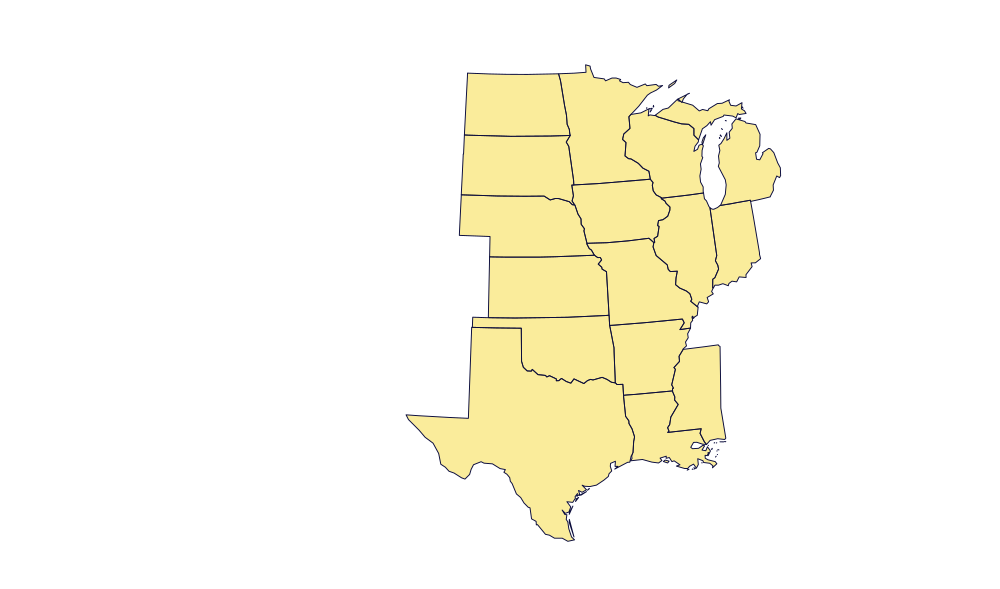
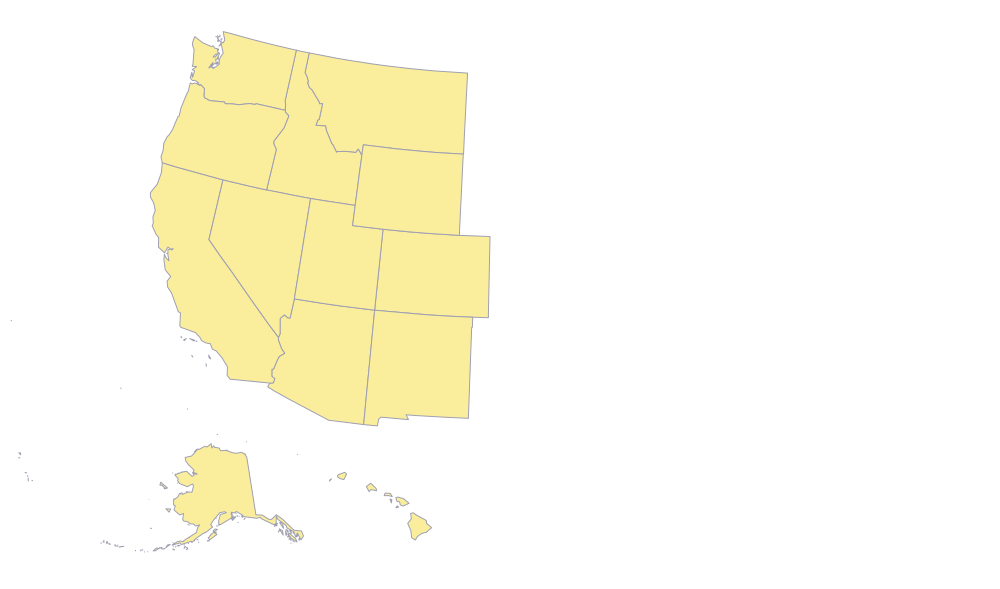
AVLS operate and has proven pool of AV technicians in major cities US Nationwide, such as Las Vegas, Los Angeles, Orlando, Dallas, San Antonio, Austin, Houston, Washington DC, Atlanta, New Orleans, Tennessee and more.
Please complete the form below and we will respond to you as soon as possible. We are available 24 hours a day to assist with your needs. We look forward to showing you what we can do toward the success of your next event.
EVENT INFORMATION
